Deal or No Deal Casino UK: Slot Rules and Bonus Play
 Available in GB
A clear guide to how the show’s case-and-Banker premise relates to slot play, bonus rounds, demos and named variants.

Table of Contents
- The Deal or No Deal Format Behind the Slot
- How the Slot’s Qualification and Bonus Round Work
- Playing Deal or No Deal Slots Online in the UK
- Free Play and Demo Versions: What Can Be Confirmed
- Double Action, Golden Box Megaways and No-Deposit Searches
- Free Spins and Box Clever: What the Available Rules Show
- What’s in Your Box? The Return Figure and Banker Offers
- Reviewing Double Action and What’s in Your Box Without Guesswork
- Perfect Play Means Choosing Between the Offer and the Briefcase
- Free Online Play: The Game’s Opening Round
The Deal or No Deal Format Behind the Slot
The familiar Deal or No Deal premise is built around uncertainty, a set of sealed briefcases and an offer from the Banker. A contestant has to decide whether the amount proposed is preferable to continuing with an unknown case value. The television format supplies the recognisable question; a casino slot uses that theme in a separate game format, with its own rules and sequence.
In the main game show, play begins with sixteen briefcases. Contestants select one to keep, then open the others over the course of the game. The amounts inside the remaining cases are gradually revealed, narrowing the range of possible values still attached to the contestant’s case. The Banker makes offers as the game proceeds, and the contestant must weigh an available amount against the unresolved possibility of a different prize.
Before the final decision, the contestant receives three offers from the Banker. Each one creates the same basic comparison: take the amount on the table, or carry on without knowing what the retained case contains. The live host asks, “Deal or No Deal?” That line is more than a catchphrase. It marks a choice between a known offer and an uncertain outcome.
For a deal-or-no-deal casino choice in the UK in 2026, payout timing is one practical detail to keep in view. These verdicts summarise the payout-speed information available for each operator.
Payout speed: 1-3 business days The listed payout speed for x3bet is 1–3 business days.
Payout speed: 1-3 business days The listed payout speed for NightWin is 1–3 business days.
Payout speed: 1-3 business days The listed payout speed for Britsino is 1–3 business days.
Payout speed: 1-3 business days The listed payout speed for NightLuck is 1–3 business days.
Payout speed: 1-3 business days The listed payout speed for SpinFormula is 1–3 business days.
Payout speed: 1-3 business days The listed payout speed for Chanze is 1–3 business days.
Payout speed: 1-3 business days The listed payout speed for WinBeast is 1–3 business days.
Payout speed: 1-3 business days The listed payout speed for Revery Play is 1–3 business days.
Payout speed: 1-3 business days The listed payout speed for Amunbet is 1–3 business days.
Payout speed: 1-3 business days The listed payout speed for EvoSpin is 1–3 business days.
The central tension comes from information arriving in stages. Every opened briefcase removes one possible value from consideration. A high value still in play can make continuing look attractive; its removal can change the calculation. The Banker’s offer responds to the game’s changing state, while the contestant has to decide whether the offer is sufficient. The show’s drama therefore comes from the gap between what is known and what remains hidden, not simply from opening cases.
A Deal or No Deal slot borrows this recognisable framework, but it is not the television contest transferred intact to a screen. A slot is a casino game governed by its own rules. The show has contestants, a live host and a sequence of Banker offers; the slot has a defined game structure and an outcome determined within that structure. Shared imagery does not make the two formats interchangeable.
That distinction matters when interpreting the word “Banker”. In the show, the Banker’s offers form part of a contest in which the contestant’s case may eventually be compared with the money offered. In a slot, the Banker is a thematic feature within the game. The presence of an offer does not, by itself, mean that the game follows every television rule or reproduces the show’s prize progression. The specific slot’s help information sets out what its features mean.
The same applies to briefcases. They are the visual shorthand that connects a Deal or No Deal slot to the television format, but their appearance does not establish how a particular game handles prizes, choices or stages. One title’s rules cannot safely be inferred from another title’s name or artwork. “Deal or No Deal” identifies a theme; the game rules determine what happens during play.
For anyone comparing the slot with the show, the useful dividing line is the role of chance and the role of choice. The television contestant makes decisions while the show reveals case values and presents offers. A slot may also present choices within a themed sequence, but those choices operate under the game’s stated rules. They should not be treated as a way to reproduce the contestant’s position, or as evidence that a particular decision can control the underlying result.

The title can therefore describe several related but distinct things: the television format, a casino slot inspired by it, or a search for a particular version of that slot. The shared premise is the contrast between a known offer and an unknown briefcase value. Beyond that premise, the relevant details belong to the individual game rather than to the television show as a whole.
For the UK audience looking at Deal or No Deal casino games in 2026, that separation keeps the comparison precise. The show provides the cultural reference: sixteen cases, three Banker offers before the final decision, and the host’s familiar question. The slot is a separate product with its own instructions. The resemblance explains the theme; it does not substitute for reading the game’s rules.
How the Slot’s Qualification and Bonus Round Work
The Deal or No Deal slot has a sequence before its central game begins: qualification comes first, Top Up is an optional step, and the Deal or No Deal game follows. That order matters. The bonus round is not simply the familiar briefcase choice carried over unchanged from the television format; access to it depends on meeting the slot’s qualification condition.
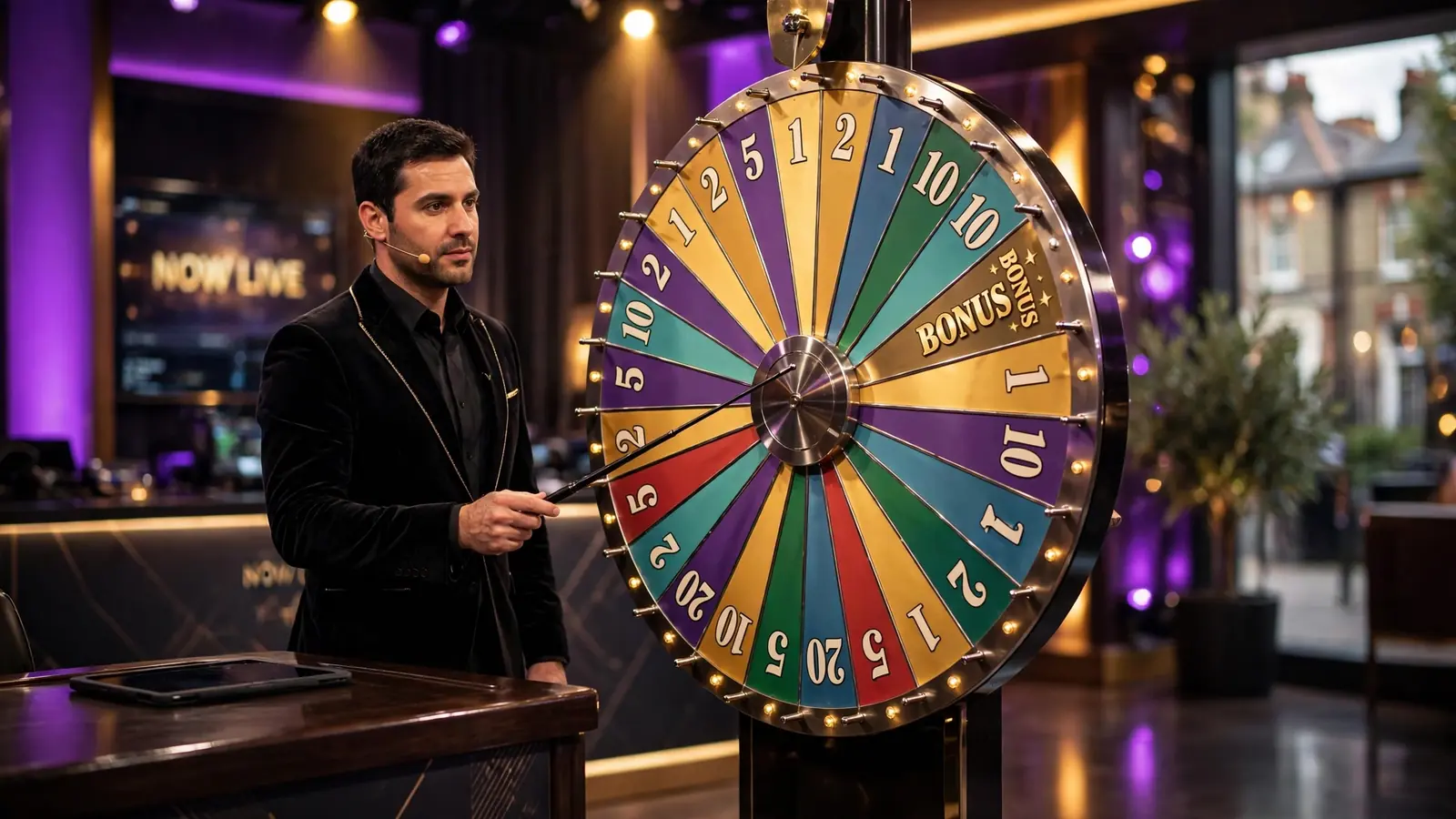
Qualification requires all three rings to land on a gold slice. The condition is specific: all three rings must meet it, not merely one or two. Until that happens, the player has not qualified for the later Deal or No Deal game. This makes the opening stage a gate in the slot’s structure, rather than a decorative lead-in to the briefcase feature.
For anyone considering a Deal or No Deal slot machine game, that distinction is useful. The qualifying condition determines whether the sequence advances to the next stage. It is separate from any decision made within the later Deal or No Deal game itself. The rings establish eligibility; they do not represent a choice between a Banker’s offer and a briefcase prize.


Once qualification is achieved, Top Up may be used to add to prizes. The feature is optional, so it is not a compulsory step between qualifying and entering the Deal or No Deal game. Its stated role is to add to prizes; that description does not, by itself, set out a specific amount or guarantee a particular final result. The order remains qualification, an optional Top Up decision, and then the Deal or No Deal game.
That sequence is the clearest way to understand how the Deal or No Deal online slot machine is organised. It has an entry condition, an optional prize-related feature, and a later game stage. These are distinct parts, not interchangeable labels for one bonus. In particular, Top Up should not be confused with qualification: qualifying is required to proceed, while Top Up is optional.
The same distinction applies when describing the Deal or No Deal online slot game as a whole. The slot does not begin with the player already choosing among briefcases. First, the rings must satisfy the gold-slice condition. Only after qualification does the optional Top Up step arise, followed by the Deal or No Deal game. A player who has not qualified has not yet reached that later stage.
The sequence also clarifies what “playing” the slot involves. To play a Deal or No Deal slot online is to take part in the slot’s stages in their stated order, rather than to assume that every session immediately opens the briefcase game. Qualification is the threshold. Top Up may then contribute to prizes, and the Deal or No Deal game comes after it.
This matters for a Deal or No Deal casino game online because the title can suggest that the briefcase feature is the entire game. In practice, the sequence includes the qualifying step before that feature. The requirement is easy to state but important to keep separate from the later choices: all three rings must land on a gold slice. The optional Top Up feature sits after qualification and before the Deal or No Deal game.
Slot Game Sequence
All three rings must land on a gold slice to allow the player to advance.
An optional step where the player may decide to add to the prizes.
The player enters the central game stage featuring the briefcases and Banker offers.
The phrase “bonus round” is often used loosely for the central feature, but the stages still have different functions. Qualification determines whether the player advances. Top Up is an optional way to add to prizes. The Deal or No Deal game is the subsequent stage. Treating them as one event can blur the point at which each condition or choice applies.
For a Deal or No Deal casino game played for real money, this sequence describes the game structure, not the value of any outcome. Qualification opens the route forward; it does not establish what a later prize will be. Top Up is described as adding to prizes, but its optional status means the route does not depend on taking it. The stages are straightforward; the key is not to attribute to one stage a function that belongs to another.
So whether the game is described as a Deal or No Deal slot game online or as a casino slot featuring the format, the basic route is the same: qualify by landing all three rings on gold slices, decide whether to use Top Up, then proceed to the Deal or No Deal game. That is the working distinction between the slot’s entry mechanism and its bonus feature.
Playing Deal or No Deal Slots Online in the UK
A Deal or No Deal title can appear in a search for online slots, but the name alone does not establish who offers it, whether a particular version is available, or which rules govern the site hosting it. In the UK, the relevant check is the operator’s regulatory status. A familiar television format is not a substitute for that check.


The UK Gambling Commission regulates commercial gambling in Great Britain, including remote gambling offered to consumers there. Its remit does not depend on where an operator keeps the equipment used to run a website or app. A business based abroad is still required to hold the appropriate UKGC licence if it offers remote gambling to consumers in Great Britain. The Commission is the sole regulator for commercial gambling in Great Britain.
What a licence check establishes
The Gambling Commission issues operating licences to gambling businesses and personal licences to certain individuals working in the industry. For a player, the operating licence is the central point: UK-facing real-money casino gambling must be provided under a current licence. A foreign address, an English-language website or a recognisable game brand does not replace that requirement.
The licence should be checked against the Commission’s public register rather than treated as a logo on a page. The register can confirm whether the named business holds a licence and whether the details correspond to the operator behind the casino. A website may use a trading name that differs from the legal company name, so both should be matched where possible. A licence number displayed on a site is useful only if it leads to a matching, current entry.
- Check the operator’s status on the UK Gambling Commission’s public register
- Match the legal company name with the trading name
- Verify that the site provides a direct link to the regulator’s record
- Rely on a license logo displayed on a webpage as sole proof
- Assume a recognizable game brand guarantees a licensed operator
- Trust an English-language website as a substitute for a regulatory check
The operator’s own website or app should also show its licence details and link to the relevant public-register information. This gives a direct route from the service being used to the regulator’s record. If those details are absent, inconsistent or lead to a different company, the licensing position is unresolved. That is a material gap, not a branding quibble.
A licensed site is subject to UK rules for remote gambling. The licence does not certify that a particular game is enjoyable, profitable or suitable for every player. It identifies the regulatory framework applying to the operator. Those are separate questions, and only the first is answered by the licence.
Rules that affect online slots
UK-licensed operators must verify a customer’s age before allowing deposits into a gambling account. Online gambling is legal for adults aged eighteen or over when it is provided by an appropriately licensed operator. Account controls are also part of the operating framework: new customers must be prompted to set a financial limit before their first deposit, and accessible account-level limit controls must be available.
There are specific restrictions on how online slots operate. Autoplay is not permitted in Britain, and a slot game cycle must take at least two and a half seconds before the next one can begin. The maximum stake in a game cycle is two pounds for customers aged eighteen to twenty-four and five pounds for those aged twenty-five or older. These are regulatory limits, not optional settings chosen by an individual casino.


Payment rules also affect the practical meaning of “online casino”. Remote gambling operators cannot accept credit-card payments for gambling, including credit-card funds routed through a money-service business. A wallet cannot be used for gambling where it allows credit-card funds to be spent on it. A payment logo therefore does not establish that every funding route is allowed.
UKGC-licensed casinos must provide responsible-gambling tools, including self-exclusion, and an internal complaints process with access to an approved Alternative Dispute Resolution service. These provisions matter if an account or transaction is disputed. The licence links the operator to defined oversight and complaint routes; it does not eliminate the need to read the terms presented by the operator.
Distinguishing the title from the casino
“Deal or No Deal” may refer to a slot, a casino game using a related title, or another format such as a Slingo-branded product. The wording is not enough to infer that two listings share the same rules or provider. Each listing should be treated as a separate product, and its own game information should be read before play. A title that sounds familiar is not a rulebook.
The same distinction applies to casinos. A site carrying a Deal or No Deal slot is not thereby approved by the game’s brand, and a game listing does not prove that the casino itself is licensed in Great Britain. The operator’s legal identity and licence are what matter for the regulatory check. The game’s name and presentation are secondary.
Licensing Risk
A business based abroad is still required to hold a UKGC licence to offer remote gambling to consumers in Great Britain.
The practical order is therefore straightforward: identify the company operating the casino, match its licence details to the UK Gambling Commission’s public register, and confirm that the site links to that record. Only after that does the individual game listing become relevant. For a Deal or No Deal slot online, the regulatory status belongs to the operator; the briefcase graphics do not carry it.
Free Play and Demo Versions: What Can Be Confirmed
A Deal or No Deal slot demo and a free-play version are not established by the game’s entry rules. Those rules describe how play proceeds: the player qualifies, can use Top Up to add to prizes, and then enters the Deal or No Deal game. They do not establish that the game can be accessed without staking money, or that a particular operator provides a demo.
The qualification condition is specific: all three rings must land on a gold slice. That identifies the point at which the player qualifies to proceed; it does not mean the qualifying sequence is itself a free-play mode. Nor does the word “demo” explain whether a version uses the same entry sequence, offers the same features or is available at a particular casino. Those are separate conditions, not consequences of the game’s name.
This distinction matters because “free play” can describe different things. It may refer to a practice version, a promotional route or simply a page that explains a game. A listing should therefore be read for the access conditions it actually states rather than treated as proof that a no-cost version is available.


The same applies to searches for a free Deal or No Deal slot game. It also does not establish whether a demo can be played without creating an account, whether it is available on mobile, or whether play in that mode follows the same rules. None of those details follows from the qualification condition.
A Megaways label raises a separate issue. The name alone is not enough to confirm that it uses the same qualification route or that it has a demo or free-play version. Any such conclusion would require details attached to that specific game, rather than an assumption based on the standard title.
For anyone comparing a demo page with a real-money listing, the useful points are the game identity and the stated access terms. A demo label indicates a format only when the listing explains what can be played and under what conditions; it does not, by itself, confirm that the version is free. The availability and conditions of free access remain distinct from those rules.
Double Action, Golden Box Megaways and No-Deposit Searches
Names such as Double Action and Golden Box Megaways point to specific versions of Deal or No Deal, but a title alone does not establish how a game plays. The standard game’s rules cannot safely be transferred to either name: features, bonus rounds, reel formats and prize structures depend on the particular version. Without confirmed rules for a named edition, claims about what makes it different would be guesswork.
The same distinction applies to casinos listing a Double Action slot. A casino’s use of a game title does not, by itself, confirm that the game has a particular feature set or that it is available in every version of the site. The practical question is what the game’s own rules say once opened. A marketing label is not a substitute for those rules.
A game title or marketing label, such as Double Action or Golden Box Megaways, is not a substitute for the specific game rules provided in the help files.
Golden Box Megaways should be treated in the same way. The word “Megaways” in a title is not enough to establish the number of reels, how wins are formed, whether the game has a special bonus or how prizes are calculated. Those details need to be stated in the specific game information rather than inferred from a name. No mechanics should be attributed to this version without that confirmation.
A Deal or No Deal no-deposit bonus is a separate matter from the slot’s own rules. The phrase does not tell how a promotion works or whether a particular casino is offering one. Eligibility, any play-through requirement, expiry and withdrawal conditions are material terms, not details that can be deduced from the game title. If those terms are not shown, the value of the offer cannot be calculated; a bonus headline alone supplies no usable final figure.
There is also no basis for treating a no-deposit promotion as a feature built into Double Action or Golden Box Megaways. A game and a casino promotion are different products: the first has rules for play, while the second has conditions set by the operator. Confusing them can make a promotional label look like part of the game when it may be unrelated.
For a fair comparison, the useful unit is not the name but the documented terms. A variant needs its own rules to support claims about how it differs; a promotion needs its own conditions to show what can be received and what must happen before any withdrawal. Where either is absent, no reliable comparison of features or value follows. That is less dramatic than the names suggest, but materially more useful.
Free Spins and Box Clever: What the Available Rules Show
Free spins and Box Clever sit in different categories of inquiry. Free spins refers to a possible promotional offer attached to a casino game or account; Box Clever is a name associated with a possible game feature. Neither label, by itself, establishes that it is available with a particular Deal or No Deal slot, or defines what it would do.

A promotion cannot be assessed from its headline alone. Its value depends on the applicable terms, including how it can be used and what conditions govern any resulting winnings. The same distinction applies when a casino advertises a promotion alongside a slot: placement beside the title does not explain whether the promotion changes the game or is separate from it.
Box Clever should be treated just as carefully. A feature name is not a rule. Without a description of its trigger, effect and relationship to the base game, it cannot support a claim about added chances, prizes or a different way to play. The name alone says nothing measurable about the outcome.
For a like-for-like comparison, the relevant evidence is the specific game’s help information and the promotion’s terms, not a label or headline. Game rules describe what happens during play; promotional terms describe the conditions attached to an offer. Combining the two can make a promotion seem like an intrinsic game feature, or make a named feature sound like a confirmed offer. Those are separate claims and require separate support.
The practical distinction is straightforward: free spins concern a promotion, while Box Clever would concern a named feature if its rules were established. Neither should be priced into an assessment of the standard Deal or No Deal game without clear, applicable terms. A promotional title can attract attention; only defined conditions determine what it is worth.
What’s in Your Box? The Return Figure and Banker Offers
The What’s in Your Box version has a reported expected return of 95.42%. A specialist review says this figure appears in the game’s help files. It is best read as a stated game-level return measure, not as a prediction of what one session will pay. The percentage does not fix the value of a prize in a particular round or guarantee that an individual player will receive a return matching it.

That distinction matters because the bonus game also includes a separate, changing decision: the Banker makes offers as batches of briefcases are opened. At each offer, the player can accept the amount offered or continue. The offer belongs to that point in that game; the expected-return figure describes the game more broadly. They measure different things and cannot be substituted for one another.
An offer may look favourable or disappointing against the prizes still in play, but its presence does not revise the stated return. Nor does the return figure establish whether a particular offer is financially attractive. That depends on the values available in the current round and the choice made at the time. The figure alone does not provide those details.
For anyone comparing Deal or No Deal slots, the useful reading is therefore narrow: the What’s in Your Box game has a reported expected return of 95.42%, while its Banker offers are made during play and can be accepted or declined in favour of continuing. The first is a reported statistical measure; the second is a live choice. Treating the percentage as a forecast for an individual game would give it a job it cannot do.
Reviewing Double Action and What’s in Your Box Without Guesswork
A useful review of a Deal or No Deal slot needs to separate its name from the outcome that can be assessed in play. “Double Action” may sound like a description of a particular feature, while “What’s in Your Box?” points towards the prize hidden in a case. Neither label, by itself, establishes how a version works or whether it changes the value of an offer.
The clearest point for evaluating the Banker’s role is what happens when an offer is accepted. The current game ends, and the player collects the amount offered. That makes acceptance a settled result, not a step that leaves the same game running with the briefcase prize still in contention. A review can therefore assess the offer as the final amount received in that round.
Game Result
Accepting the Banker’s offer ends the round and establishes the final amount received, regardless of the prizes in the remaining briefcases.
This distinction matters when comparing an offer with a possible prize. The offer is a stated amount available at that moment; it is not a guarantee about what an unopened briefcase contains. Once accepted, the offered sum is the result of that game. A review that treats the offer as merely indicative, while implying that the round continues, misstates the transaction.
For a Double Action review, the same standard applies: describe a feature only when its operation is clear, and do not infer extra rounds, multipliers or improved returns from the title. For a What’s in Your Box review, keep the concealed prize separate from the Banker’s accepted offer. The name does not make the hidden amount known.
A practical assessment can thus focus on a verifiable outcome: whether the offer is accepted and, if so, the amount awarded. That is a narrower basis than a score built on assumptions about a title, but it is also more useful. The result has a definite endpoint and a definite payment: the game closes, and the accepted offer is collected.
Perfect Play Means Choosing Between the Offer and the Briefcase
“Perfect play” in a Deal or No Deal slot is not a fixed route to a better result. The final decision is a choice among the Banker’s offer, the prize in the player’s briefcase, and the prize in the last unopened briefcase. The game presents alternatives; it does not make one of them a guaranteed winning move.
Accepting the offer ends that game, and the player collects the amount offered. That turns the remaining decision into a settled outcome: the briefcases no longer determine the result. The value of the offer can therefore be assessed as the amount being taken in place of either unresolved briefcase prize. It is a known figure against two unknown ones, not a prediction about which case contains more.

Rejecting the offer leaves the player with the briefcase prize. Switching instead means choosing the last unopened briefcase. Those routes preserve uncertainty: the final amount depends on the prize attached to the selected case. Switching is not, by itself, evidence that the other case is more valuable; keeping the original is not evidence that it is safer.
A useful way to describe the decision is to separate certainty from possibility. Taking the offer fixes the result at the offered amount. Continuing with a briefcase leaves the result tied to its prize. No choice can be called perfect without knowing the values inside the cases, and that knowledge is precisely what the game withholds.
The practical distinction is between ending the game on a stated offer and allowing the chosen briefcase to determine the prize. The term “perfect play” may suggest a method that removes chance, but these final options do not provide one. They define how the game ends, not a reliable way to improve its outcome.

Free Online Play: The Game’s Opening Round
The opening round gives the Deal or No Deal slot its first decision point. Play begins with 16 briefcases, each concealing a prize. Three are opened, revealing their contents and removing those prizes from the remaining choices.
The Banker then makes an offer. The player must decide whether to accept it or continue: “Deal” ends the game with the offered amount, while “No Deal” keeps the round in progress. The offer is therefore a choice between a known sum and the unresolved briefcases, not a guarantee of what those cases contain.
This sequence explains the game’s structure, but it does not establish that a free online version is available. A free-to-play label, where shown by a particular site, would need to be checked there; it should not be inferred from the slot’s opening rules. The first round itself is straightforward: open three cases, receive the Banker’s offer, then choose whether to stop or carry on.
Prepared by the Vegas Moose Casino 3 editorial staff.