Bonus Buy Slots in the UK: Features and Demo Play
 Available in GB
See how demo mode, slot features, volatility and Great Britain’s stake limits affect the way bonus-buy games work.

Table of Contents
- Testing Bonus Buys in Demo Mode
- Bonus-Buy Casinos: The UK Account Conditions
- What the Bonus-Buy Feature Actually Changes
- Slots With a Buyable Bonus: Reel and Payline Structure
- Bonus-Buy Slots and the Cost of Volatility
- Free Play: What the Balance Can and Cannot Do
- Online Bonus-Buy Slots Under Great Britain’s Stake Limits
- Slot-Game Features Behind a Bonus Buy
- How to Identify Slots With a Buyable Bonus
- Live Casino and Table Games: Roulette Mechanics
Testing Bonus Buys in Demo Mode
A demo session is useful when it is treated as a test of game behaviour, not as a preview of possible cash winnings. It can show whether results tend to arrive as frequent small returns or as less frequent, larger ones, and whether a short run gives a misleading impression of the slot’s rhythm. Demo credits are simulated. They are not real money, cannot be withdrawn and produce no real-money payout.
For anyone comparing bonus buy video slots, the first practical check is whether the demo includes the same features as the real-money version. Some games may show a feature purchase in demo mode; others may disable it or omit the option altogether. The interface should make clear which version is running. If the feature cannot be tested, ordinary demo spins can still reveal aspects of the base game, but they cannot stand in for a test of the purchase itself.
What a demo can show
Volatility is about the pattern of returns, not whether a particular session ends ahead. In a low-volatility slot, returns are spread across many smaller wins. A high-volatility slot pays less often, with returns tending to be larger when they do arrive. Watching a sequence of demo spins can therefore help distinguish a steady trickle of modest results from longer quiet stretches interrupted by larger ones.
Choosing a bonus buy slot involves more than the game itself; it is also worth checking the practical details of the casino. The listed payout speed gives one point to consider when reviewing these options.
Payout speed: 1-3 business days x3bet lists a payout speed of 1–3 business days. This is a practical detail to consider when assessing the operator for bonus buy play.
Payout speed: 1-3 business days NightWin lists a payout speed of 1–3 business days. This provides a useful withdrawal detail when considering the operator.
Payout speed: 1-3 business days Britsino lists a payout speed of 1–3 business days. Keep this timing in mind when reviewing it for bonus buy slots.
Payout speed: 1-3 business days NightLuck lists a payout speed of 1–3 business days. This is the available practical detail to weigh when considering the operator.
Payout speed: 1-3 business days SpinFormula lists a payout speed of 1–3 business days. That gives players a stated withdrawal timeframe to consider.
Payout speed: 1-3 business days Chanze lists a payout speed of 1–3 business days. This is a useful practical point when assessing the operator.
Payout speed: 1-3 business days WinBeast lists a payout speed of 1–3 business days. Consider this stated timeframe as part of your review.
Payout speed: 1-3 business days Revery Play lists a payout speed of 1–3 business days. This provides a withdrawal detail to consider when reviewing the operator.
Payout speed: 1-3 business days Amunbet lists a payout speed of 1–3 business days. This is the available practical detail to note for players considering the operator.
Payout speed: 1-3 business days EvoSpin lists a payout speed of 1–3 business days. This stated timeframe may be useful when assessing the operator.
That observation has limits. A brief demo run may contain an unusually active patch or an unusually quiet one. Neither establishes how the game will behave over a longer period. A session that produces several wins close together does not prove that the slot is low-volatility; a dry spell does not prove the opposite. Demo play gives a sample of outcomes, not a reliable forecast.
A useful record is qualitative rather than a tally presented as a prediction. Note whether wins appear often, whether most are small, and whether a small number of larger outcomes account for much of the session’s apparent return. Also note how the balance changes after wins and losses. That makes it easier to compare games on the shape of their results instead of relying on a single memorable spin.
Where a demo allows the buyable feature to be activated, the feature round can be observed in the same way: what kind of outcomes appear, how varied they are, and how much the final result depends on a standout event. The display may also show the cost of entering the feature, but demo credits do not turn that cost into a real financial test. A simulated balance has no cash value, so any gain or loss on screen remains part of the demonstration.

Comparing demo sessions
The best bonus buy slots demo UK searches often lead to a broad mix of games, but a comparison is only useful when the conditions are reasonably consistent. Changing the stake, switching between the base game and a feature round, or comparing one very short session with a much longer one makes the results harder to interpret. Keeping the observations separate is more informative than combining everything into one apparent average.
A simple note can include the game, the mode tested, and a description of the run: frequent small wins, occasional larger wins, or long gaps between returns. If the demo resets its balance or does not preserve session history, that limits how much can be compared. It does not make the demo worthless; it means the result should be treated as a visual sample rather than a measured long-term rate.
The same caution applies when looking for bonus buy demo slots in the UK. A demo may help assess presentation and the distribution of results encountered during play, but it cannot establish the value of paying for a feature. Nor can it reproduce the financial pressure of using real money. The balance is simulated, and the emotional weight of a virtual loss is not the same as the cost of a real one.
That distinction matters when selecting a demo bonus-buy slot to inspect. The useful outcome is a clearer description of the game’s behaviour: whether wins seem frequent or sparse in the observed run, and whether returns are mostly small or driven by occasional larger results. It is not evidence that a real-money session will repeat the same sequence. A demo can make the mechanics visible; it cannot convert randomness into a promise.
Attention: Demo play provides a sample of outcomes but cannot establish the value of paying for a feature or reliably forecast real-money results.
Bonus-Buy Casinos: The UK Account Conditions
Access to a casino with a buyable bonus depends first on the operator’s legal status and the account checks attached to real-money gambling. A slot’s feature setting does not bypass those conditions. An account may be created before all checks are complete, but an operator must verify a customer’s age before allowing a deposit.
Online gambling is legal in the UK only through licensed and regulated sites. The UK Gambling Commission regulates gambling activity, including online casinos, and is the sole regulator for commercial gambling in Great Britain. Remote operators serving consumers in Great Britain must hold the relevant Commission licence even when their key equipment is located elsewhere. The Commission issues operating licences to businesses and personal licences to individuals working in regulated roles.
The Gambling Act 2005 governs gambling in England, Wales and Scotland, rather than Northern Ireland. That distinction matters when describing the scope of the British licensing system: the Commission’s remit over remote gambling is specifically tied to services offered to consumers in Great Britain. A site’s use of UK currency or British-facing branding does not establish that it holds the required authorisation.
Licence checks come before deposits. The Commission’s public register allows the operator’s licence status to be checked. The operator name should match the business shown on the register, and the licence should be current. A logo or licensing statement on a website is not a substitute for checking the register itself. If the business cannot be matched, the account should not be treated as a licensed UK casino account.

Age and identity checks are part of account access, not optional paperwork to be postponed indefinitely. The age check must be completed before a deposit is permitted. Operators may also request information to confirm identity or meet their regulatory duties. Until an account is verified, deposit or withdrawal functions may be restricted; the precise process depends on the operator’s terms, so those terms need to be read before money is transferred.
Financial controls are another required part of the account. Remote operators must prompt new customers to set a financial limit before their first deposit and provide accessible account-level controls for managing limits. These controls can make spending boundaries visible within the account, but they do not change the cost or outcome of a game. A limit is useful only if its scope is clear: the account terms should explain which activity it covers and how changes take effect.
Payment rules also narrow the available methods. UK-licensed casinos cannot accept credit cards for gambling. Operators also cannot accept wallet payments where the wallet allows credit-card funds to be used for gambling. A payment option appearing on a cashier page is therefore not proof that every funding route through it is permitted.
Complaint handling should be identifiable before an account is opened. UK Gambling Commission licensees must provide an internal complaints process and access to an approved Alternative Dispute Resolution service. The operator’s terms should set out how a complaint is submitted and how unresolved disputes can be referred onward. Keeping account messages and transaction records makes the issue easier to describe and assess.
Self-exclusion is a required safer-gambling tool at UK-licensed casinos. It allows an account holder to exclude themselves from gambling with the operator, rather than simply relying on a deposit control. GAMSTOP is the national online self-exclusion scheme for participating UK-licensed operators. The scheme and the casino’s own account tools serve distinct purposes, so the operator’s self-exclusion information should be checked alongside any broader exclusion preference.
For an online casino bonus buy, these conditions are the entry framework: valid licensing, age verification, financial controls, permitted payments and usable routes for complaints or exclusion. None establishes that a particular game is suitable or that a feature purchase will return its cost. They establish whether the account is operating within the UK regulatory system.
What the Bonus-Buy Feature Actually Changes
In an ordinary slot, a bonus round becomes available when the game’s rules trigger it during regular spins. A bonus-buy feature changes that route: instead of waiting for the trigger, the player pays the displayed price to enter the bonus round directly. The purchase changes how access is obtained; it does not turn the round into a guaranteed win.
The distinction is between paying for an opportunity to play a different phase of the game and reaching that phase through the normal spin sequence. With ordinary play, the bonus may or may not appear during a session. With a buy feature, access is immediate once the purchase is accepted, subject to the game’s rules. The feature price is therefore a cost of entry, not a forecast of what the round will return.
A bonus round is a separate set of game actions governed by its own rules. Depending on the game, those rules may involve additional spins or another specified interaction. The purchase does not necessarily change the underlying symbols, payout table or conditions attached to wins. It provides access to the feature as designed by that slot; the resulting outcome remains uncertain.

The monetary calculation has two parts: the amount spent to buy access and the result of the feature round. A return can be lower than the purchase cost, higher than it, or absent. Paying the price does not establish a minimum payout, and a feature’s name or presentation does not alter that arithmetic. The purchase is an additional decision within the game, not a refund arrangement or a promise of profit.
This also explains why a buyable bonus is not simply a more frequent version of an ordinary bonus trigger. The route to entry changes, while the bonus outcome still depends on the game’s mechanics. In ordinary play, the player spends on spins and may reach the feature as part of those spins. With a purchase, the player spends specifically to enter the feature. Neither route removes the uncertainty attached to the round.
Some bonus rounds use multipliers on wins accumulated during the feature. In that design, the multiplier affects qualifying wins according to the game’s rules; it is not an independent cash amount. A multiplier can increase a calculated win, but it cannot ensure that a win occurs or that the final result exceeds the price paid for entry.

Low-volatility slots typically include bonus rounds built around multipliers applied to accumulated wins. Their wider design may also include five reels, at least twenty-five paylines and fixed jackpot amounts rather than progressive pools. Those characteristics describe a type of game configuration, not a special guarantee attached to buying its bonus. A multiplier-based round still depends on the symbols and outcomes produced within it.
The practical point is narrow: buying a bonus replaces the wait for an in-game trigger with paid access to a feature round. It does not buy a particular result. The displayed purchase price is the cost; the eventual return is a separate, uncertain outcome.
Slots With a Buyable Bonus: Reel and Payline Structure
A buyable bonus sits within a slot’s existing game layout; it does not turn the reels into a separate table game. The reels, symbols and paylines remain the framework for ordinary spins. That structure matters because a stake may be applied across all five reels, rather than treated as a separate wager on each reel. The game’s rules determine how that stake is recorded and how winning combinations are assessed.

A five-reel layout describes the columns of symbols visible as the game runs. It does not, by itself, explain how a win is formed. Paylines provide that additional rule: they specify paths across the reels on which matching symbols can count as a combination. Those paths may be shown as lines on the game screen or explained in its rules. A player assessing a slot should distinguish the visual reel arrangement from the paths that qualify for a win.
The distinction is practical. Two games can both show five reels while using different payline arrangements and symbol rules. The reel count alone cannot establish which symbol patterns pay, or whether a particular line is active. The paytable and game rules supply that information. A screen that looks familiar is not a substitute for checking how the game evaluates a result.
Stake presentation also deserves attention. Where a bet applies across all five reels, the displayed amount relates to the spin as a whole; it should not be casually read as five separate amounts. The precise display and wording are game-specific, so the rules should be read alongside the stake controls. This is a matter of understanding the unit being wagered, not judging whether the game is favourable.

Payline diagrams can clarify what the game counts, but they do not change the underlying layout. They show eligible routes through the reels, while the paytable explains the symbols and combinations associated with those routes. If a slot uses a different way to assess wins, that should be set out in its own rules rather than assumed from the appearance of the screen. The useful comparison is therefore between documented game structures, not labels such as “five-reel” on their own.
For slots with a buyable bonus, reel and payline structure remains relevant before any feature is considered. It defines the ordinary play environment in which the game operates and helps make sense of the stake display and result evaluation. It does not, on its own, explain the bonus purchase, predict a return or indicate how often a winning combination will appear. Those are separate questions from the geometry of the reels.
A five-reel layout describes the columns of symbols, while paylines specify the paths across those reels that qualify for a win.
A careful inspection starts with the reel layout, then checks how the stake applies and how winning paths are described. That keeps three things separate: the columns shown on screen, the routes that qualify as paylines, and the amount wagered for a game cycle. A buyable bonus does not remove the need to understand those basics.
Bonus-Buy Slots and the Cost of Volatility
Volatility describes the pattern of returns, not whether a slot is profitable. A low-volatility game tends to return value through many smaller wins. A high-volatility game produces wins less often, with larger amounts when they occur. Neither pattern guarantees that a session will end ahead; it changes how unevenly results arrive.
That distinction matters when a bonus can be bought. The feature may make a particular round available without waiting for it to appear during ordinary play, but access to a bonus is not the same as access to a profit. A purchase does not cancel the game’s house edge. If the game has a positive house edge, its mathematical expectation remains negative over enough sessions, even when losses arrive gradually rather than in a single sharp decline.
Volatility affects the route to that result. In a low-volatility slot, frequent small wins can soften the visible movement of the balance. They may offset some losing spins, but their frequency alone does not establish that the total returned will exceed the total staked. In a high-volatility slot, longer stretches without a meaningful win can make the balance fall more abruptly; a larger payout may follow, but its timing and size are not assured. A buyable feature does not turn either pattern into a reliable schedule.

The practical cost is therefore not just the price attached to entry into a bonus round. It is the uncertainty around what that round returns and how much of the session balance remains afterward. Two games can offer a similar feature while producing very different sequences of wins and losses. The label “bonus buy” says that a feature can be accessed through a purchase; it does not state the feature’s likely return or the chance of recovering that purchase.
A useful comparison separates three questions: how frequently the game tends to return smaller wins, how much variation is built into its payouts, and whether its mathematical expectation is positive or negative. The first two describe the experience of variance. The third concerns the long-run direction of value. A game can feel generous because small wins appear often while still carrying a negative expectation overall. Conversely, an occasional large result does not make a high-volatility game favourable.
For bonus buy slots in the UK, the purchase should therefore be treated as exposure to another uncertain outcome, not as a shortcut around the economics of the game. Lower volatility can make results look steadier; higher volatility can make them more pronounced. Neither changes the basic calculation when the house edge is positive: across enough sessions, the expected result is negative. The timing of that cost varies. The underlying arithmetic does not.
House Edge
Regardless of volatility or the use of a bonus-buy feature, the mathematical expectation remains negative over enough sessions if the house edge is positive.
Free Play: What the Balance Can and Cannot Do
A free-play balance is simulated. It can fund spins in a game mode without representing money deposited or won, and any increase shown on screen remains part of that simulated balance. It cannot be withdrawn, transferred into a real-money account or paid out as cash. A large displayed total is still not a cash balance.
That distinction matters when a slot offers a buyable bonus. In free play, the feature purchase—if available in that mode—is made with the mode’s simulated credits. Any resulting feature round and displayed win remain within the same practice environment. The screen may show a cost and a result, but neither creates a real-money transaction or entitlement to a payout.
Free play therefore answers a limited question: what happens within this session’s rules when simulated credits are used? It does not establish that a real-money session would produce the same outcome, nor does it create winnings that can later be claimed. The word “bonus” can describe a feature inside the game; it does not turn free-play results into a casino bonus or withdrawable funds.
The same boundary applies to bonus-buy slots in free play across UK-facing sites. The mode can make the game available without staking real money, but its balance has no cash value. A player may see credits deducted for a feature and credits added after a round; those movements are bookkeeping within the simulation. They should not be read as evidence of a payable return.
This also separates free play from demo testing. Free play describes the simulated balance and the absence of real-money payouts. Demo testing is a way to examine how a slot behaves, such as how its bonus-buy option is presented or how a feature round unfolds. The two can overlap when a game is opened in a free mode, but they answer different questions: one concerns the status of the balance, the other concerns observation of the game.

For anyone comparing free-play bonus-buy slots, the practical limit is straightforward: outcomes can be viewed, but they remain simulated. A free-play session cannot prove what a real-money session will return, and no displayed result becomes cash winnings. The balance is useful only inside the mode that created it.
Online Bonus-Buy Slots Under Great Britain’s Stake Limits
A specialist gambling review reports two maximum online slot stakes in Great Britain: £2 per game cycle for customers aged 18 to 24, and £5 per cycle for those aged 25 or over. The age bands determine the applicable ceiling; the limit is not a suggested stake or a target for play.
A game cycle is the relevant unit. The figures do not describe a session budget, a daily allowance or a guaranteed cost for accessing a bonus feature. Nor does the existence of a buyable bonus remove the slot’s stake limit. The review’s figures are stated as limits on online slot stakes, not as a separate price schedule for every bonus-buy option. The purchase mechanism and the stake shown by the game should therefore not be treated as interchangeable without checking how that particular game presents them.
These limits do not amount to a blanket ban on bonus-buy slots in the UK. They govern the stake in online slot play; they do not establish that every game offers a buyable feature, or that every feature is available at the same cost. The practical distinction is between a restriction on the amount staked in a slot cycle and the game’s own rules for accessing its bonus.

The same specialist review distinguishes slots from roulette and blackjack: it says the Great Britain online slot stake limits do not apply to those table games. That is a difference in the scope of the stated limits, not evidence that roulette or blackjack follow the same stake rules as slots. A bonus-buy feature belongs to a slot, so the table-game distinction does not provide an alternative route to purchasing one.
For searches about online bonus-buy slots in the UK, the relevant point is the age-based cap on slot stakes, rather than a separate rule banning the feature. Free online play is a different matter: a simulated balance is not a real-money stake and does not produce a cash payout. In real-money play, the age band and the slot game cycle remain the relevant reference points.
The stated figures come from a specialist review, so they should be read as that review’s account of the limits, not as a substitute for checking the current rules that apply to an account and game. The distinction between a slot and a table game matters: the review assigns the caps to online slots and expressly excludes roulette and blackjack.
Slot-Game Features Behind a Bonus Buy
The bonus-buy label describes an available feature, not a uniform game design. The underlying slot still has its own layout, prize structure and bonus-round rules. Those details matter when comparing bonus-buy slot games: a similar feature label does not mean that two games distribute prizes in the same way.

A typical low-volatility configuration has five reels and at least twenty-five paylines. It may use fixed jackpot amounts rather than a progressive pool, and its bonus rounds may apply multipliers to wins accumulated within the round. These are characteristics associated with low-volatility slots, not requirements that every game with a buyable bonus must meet.
The distinction between a fixed jackpot and a progressive pool is structural. A fixed amount remains set rather than growing as contributions feed a shared prize pool. That describes how the jackpot is organised; it does not establish how often it will be awarded or what a particular session will return.
Multipliers also need to be read in context. In this configuration, they relate to wins accumulated during the bonus round. The multiplier is a feature of the round’s prize calculation, not evidence by itself that the game is generous. The game’s own rules determine how the multiplier applies, so the label alone cannot establish the value of a result.
For anyone assessing slot games where a bonus can be bought, the useful comparison is therefore between stated game attributes: reel and payline layout, whether jackpot amounts are fixed or progressive, and whether bonus-round wins can be multiplied. These details describe the game’s structure without implying that the purchase changes its underlying prize design.
A game can depart from the typical low-volatility pattern and still offer a buyable bonus. The feature and the game profile are separate questions: one concerns access to a bonus round, while the other concerns the slot’s configuration and the way its bonus prizes are treated. Reading both sets of rules prevents a familiar feature name from being mistaken for a full description of the game.
Identifying Bonus Buys
Launch the slot and open its information or help panel to inspect feature descriptions.
Look for an explicitly labelled purchase control, such as “Bonus Buy” or “Feature Buy.”
Confirm the control refers specifically to purchasing a bonus round rather than a standard spin.
How to Identify Slots With a Buyable Bonus
A slot’s title or promotional image does not establish whether its bonus can be purchased. The reliable check is inside the game itself: open its information panel and inspect the feature descriptions, then review the playing interface for a clearly identified purchase option. Wording varies, but terms such as “Bonus Buy” or “Feature Buy” indicate what to look for rather than guaranteeing that a particular game offers it.
The game’s own controls should make the distinction clear. A standard spin button starts ordinary play; a separate, explicitly described option is needed to confirm that a bonus can be bought. If the information panel describes bonus rounds but the interface provides no purchase control, that is not evidence of a buyable feature. A bonus that can only arrive during ordinary spins is a different arrangement.
On a small screen, controls may be grouped in a menu rather than displayed beside the spin button. Checking the game’s help or rules panel can clarify whether a purchase option exists and how the game identifies it. If the wording remains ambiguous, the feature should not be treated as available. An assumption based on another slot from the same provider is not a substitute for checking the individual game.
The same check applies when asking which slots can be bought in the UK: availability needs to be established for the specific game being opened, not inferred from a broad category such as 5 reel slot games. A five-reel layout describes the reels; it does not, by itself, tell whether a bonus purchase is offered. Nor does seeing a bonus symbol or reading about a bonus round confirm that it can be purchased.
A practical identification sequence is therefore simple: open the slot, read its own feature information, locate an explicitly labelled purchase control, and confirm that the control refers to a bonus rather than an ordinary spin. If any part is unclear, the game has not yet been verified as a slot with a buyable bonus.

Live Casino and Table Games: Roulette Mechanics
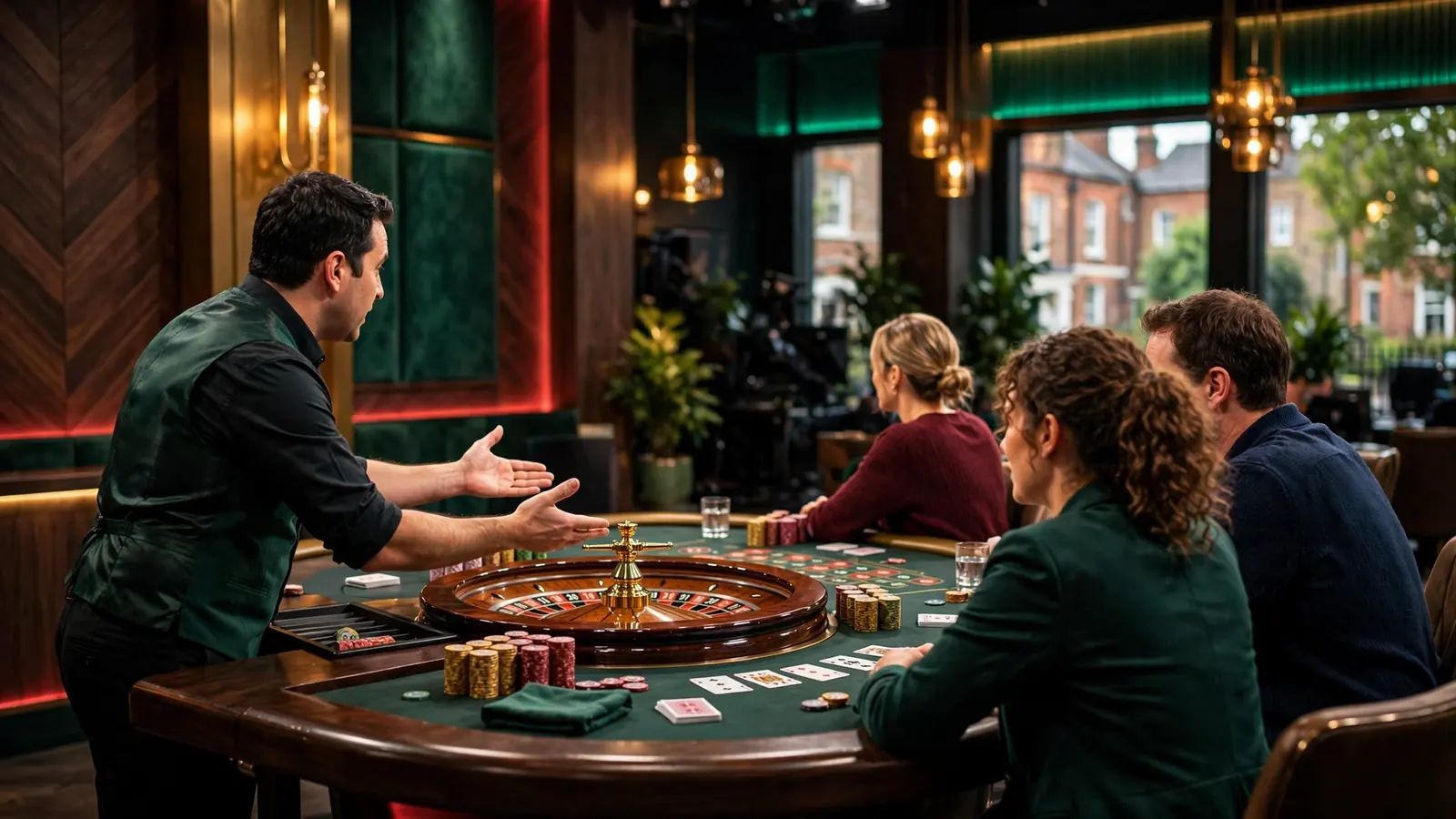
Roulette is a table game, not a slot with a buyable bonus. Its outcomes come from a ball landing in a numbered pocket, and the wheel format determines which pockets are available. A live dealer presents the same basic choice of bets as a digital roulette table; the bonus-buy feature belongs to a different category of game.
European-style roulette has 37 pockets: a green zero and numbers from 1 to 36. French roulette uses the same pocket count and numbering. American-style roulette has 38 pockets, adding a double zero alongside the zero and numbers 1 to 36. That extra pocket changes the set of possible outcomes, so the formats are not interchangeable for comparing a bet.
A straight-number bet selects one pocket. If the ball lands on that number, the stated payout is 35:1. The payout is separate from the stake returned, so it should not be read as the total amount credited. A split covers two adjacent numbers; a street covers three consecutive numbers. These bets cover more pockets than a straight bet, while changing the payout attached to a winning result.
Other roulette bets cover broader groups. Low or high, odd or even, and red or black are outside bets with a 1:1 payout. Dozens and columns pay 2:1. The selection is placed before the ball is released at the start of a round; once it is in motion, the available outcome is already being determined.
For a practical comparison, the wheel format and bet type matter more than whether the table is live. A bonus-buy slot offers a purchase that starts a feature round; roulette has no equivalent mechanic in these rules. Treating the two as the same kind of casino game obscures how each one produces a result.
Created by the ”Vegas Moose Casino 3” editorial team.