
Hi-Lo Casino UK: Rules, Choices and Payouts
 Available in GB
Hi-Lo compares card ranks, with outcomes shaped by whether the next card is higher, lower or the same value.
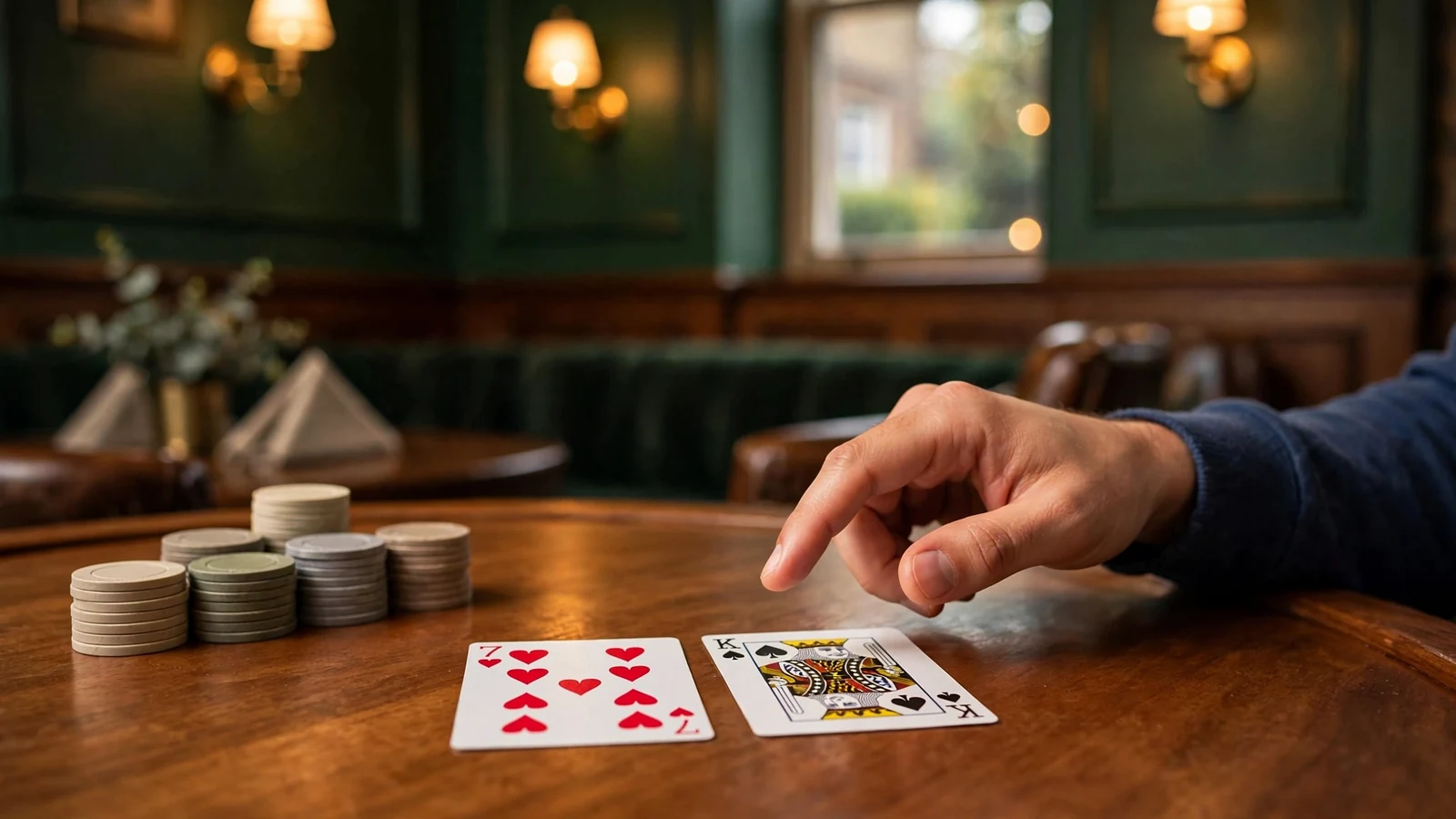
Table of Contents
- How Hi-Lo Card Rounds Work
- The Online Hi-Lo Game: Cards, Pot and Payouts
- Draw Hi-Lo: Decisions, Ties and Cashing Out
- Hi-Lo Strategy: Compare the Return Before Choosing
- Live Hi-Lo: The Shoe and the Reference Card
- Live Online Hi-Lo on a Reel
- Checking a Hi-Lo Casino Site in the UK
- Playing Hi-Lo Online: When to Stop and What a Loss Means
How Hi-Lo Card Rounds Work
A Hi-Lo card round turns one comparison into a choice: will the next card rank above or below the card already shown? The exposed card is the reference point. A player selects Higher or Lower, then the next card is revealed and the two ranks are compared. It is a small decision with a precise outcome; suits do not determine whether a card is higher or lower.
If the new card is higher, a Higher prediction is correct and a Lower prediction is wrong. If it is lower, the reverse applies. The same-value result is different: it is neither higher nor lower. A Higher or Lower bet loses when the next card matches the current card.
Some versions offer a separate option to predict that the next card will have the same value. That changes the available choices, but it does not make a tie part of a Higher or Lower prediction. The round’s result depends on the option selected and the relationship between the two card values.
When choosing a hi-lo casino in the UK for 2026, payout timing is one practical detail to check. The verdicts below summarise the available information for each option.
Payout speed: 1-3 business days x3bet lists a payout speed of 1–3 business days.
Payout speed: 1-3 business days NightWin lists a payout speed of 1–3 business days.
Payout speed: 1-3 business days Britsino lists a payout speed of 1–3 business days.
Payout speed: 1-3 business days NightLuck lists a payout speed of 1–3 business days.
Payout speed: 1-3 business days SpinFormula lists a payout speed of 1–3 business days.
Payout speed: 1-3 business days Chanze lists a payout speed of 1–3 business days.
Payout speed: 1-3 business days WinBeast lists a payout speed of 1–3 business days.
Payout speed: 1-3 business days Revery Play lists a payout speed of 1–3 business days.
Payout speed: 1-3 business days Amunbet lists a payout speed of 1–3 business days.
Payout speed: 1-3 business days EvoSpin lists a payout speed of 1–3 business days.
The term “Hi-Lo” describes the comparison, not one universal set of rules. A hi lo casino game may present the choice as a single decision, or place it within a sequence of decisions. The basic comparison remains the same, but the treatment of a correct prediction, a wrong one or a matching rank can depend on the version being played. The rules shown for the particular game therefore determine what happens after the reveal; the name alone does not settle every detail.
For a simple example, suppose the current card is a five. A prediction of Higher succeeds if the next card ranks above five and fails if it ranks below five. If another five appears, the Higher bet loses under the stated rule. A Lower prediction reverses the first two outcomes but also loses on the matching five. This is why a tie should not be treated as a neutral result for either directional bet.
The comparison is made against the current card, not against a remembered sequence or a card’s suit. After the next card appears, that card can become the reference for another choice in versions that continue the round. The central mechanic is therefore easy to state: choose a direction, compare the revealed rank with the reference rank, and apply the game’s rule for a match. The exact consequences beyond that comparison belong to the individual format.


The Online Hi-Lo Game: Cards, Pot and Payouts
The central choice is whether the next card will rank above or below the card currently shown. Each reveal becomes the basis for the next prediction, so the decision depends on the visible card rather than on a fixed sequence. The game’s value scale runs from ace at one point through to king at thirteen. A higher card has a greater value on that scale; a lower card has a smaller one.
A correct prediction adds winnings to the pot. An incorrect prediction loses the money placed on that guess, and the winnings accumulated in that game are void. The pot therefore records the result of successive decisions, but it is not protected from a later mistake. A growing total is still exposed to the next prediction.
Card supply affects how that sequence should be understood. One description of the online game specifies a single 52-card deck, with cards removed after they are used. Under that account, a card already revealed cannot return during the same game. The remaining possibilities change after each reveal because the used card is no longer available.
There is, however, a direct disagreement over the deck setup. A specialist review describes six decks of 48 cards with continuous shuffling, rather than one 52-card deck from which used cards stay out. These are materially different arrangements: one makes previous reveals relevant to the cards still available, while the other describes multiple decks being shuffled continuously. The six-deck account is a description from that review, not an established rule for online Hi-Lo as a whole. The game’s displayed rules are therefore the relevant statement of the format in operation.
Deck Setup
A single 52-card deck without replacement differs materially from a six-deck setup with continuous shuffling, as the former makes previous reveals relevant to remaining cards.
This distinction matters when reading a run of cards. In a single-deck version without replacement, the visible sequence changes the composition of the remaining deck. In a continuously shuffled multi-deck version, that same sequence does not establish that a particular card has been removed from future play in the same way. The interface may look similar, but the underlying card supply is not interchangeable.
The payout table determines how a successful guess translates into the pot. A correct call may add winnings according to the game’s stated payment, while an incorrect one removes the stake and voids the collected winnings for that game. The pot should therefore be read as a running game balance, not as a guaranteed amount awaiting collection. No universal payment can be inferred from the basic higher-or-lower mechanic alone; the displayed rules and pay table define the particular version.
For a UK player comparing online Hi-Lo formats in 2026, the practical distinction is between the visible decision and the deck model behind it. The first is common to the descriptions: predict the next card’s direction by rank. The second is disputed, and it changes what can be concluded from cards already seen. The game screen’s stated deck and payout rules determine which version is being played.
Draw Hi-Lo: Decisions, Ties and Cashing Out
Draw Hi-Lo uses a single 52-card deck. Aces are low, and each card is removed from play once it has been used. The deck therefore changes as a game progresses: a card already seen cannot be drawn again in that game.


Play begins with a randomly dealt card. The player then predicts whether the next card will rank higher or lower, unless the choice is not offered for that position. A correct prediction pays according to the game’s pay table. If the next card matches the current card, the result is a push; neither a win nor a loss is recorded for that decision. A wrong prediction loses the bet.
The changing deck is a key distinction in this hilo casino game. A prediction is made against the card currently shown, but the possible next cards are also affected by every card already removed. The available outcomes are not reset between decisions within the same game. That makes Draw Hi-Lo different from a format in which cards are returned or reshuffled between rounds.
There is also a clear point at which winnings can be taken. After the first decision, the player may end the game and collect the winnings accumulated so far, or continue making predictions. The choice is therefore not limited to deciding higher or lower: continuing puts the current winnings at risk in exchange for another possible payout.
That cash-out option changes the shape of the game, not the result of an individual prediction. Correct guesses are paid under the pay table, ties push, and incorrect guesses lose. A player who stops after the first decision keeps the winnings accumulated to that point; a player who continues faces further decisions with fewer cards remaining in the deck.
Draw Hi-Lo Essentials
- Uses a single 52-card deck where cards are removed after use.
- Ties result in a push, meaning neither a win nor a loss is recorded.
- Players have the option to cash out and collect accumulated winnings after the first decision.
Hi-Lo Strategy: Compare the Return Before Choosing
Hi-Lo strategy is a comparison of the return attached to each available choice, not a way to make an uncertain card predictable. The useful distinction is between a strategy’s reported return and the result of an individual round: a return figure describes an aggregate calculation, while each decision can still produce a win or a loss.
A specialist review reports a 96.07% return for basic strategy in Draw Hi-Lo. The same review gives a 100.36% return when card counting is used. These are reported figures for the strategies described, not guaranteed outcomes for a particular session or a universal rate for every Hi-Lo game. The game rules, pay table and method of play matter to what a return calculation represents.
The comparison is direct: the reported card-counting return is higher than the reported basic-strategy return. That does not mean every counted decision wins, or that the player can expect the stated return from a short run of play. A return is a modelled measure across repeated decisions. A particular sequence can finish well below it, and the figure does not remove the possibility of losing the stake.
What the return figures tell you
A return percentage expresses the calculated amount returned relative to the amount staked over the play covered by the calculation. It is not the same as a probability of winning a single guess. Nor does it specify the final result of a session. Treating a return as a promise would turn an accounting measure into something it is not.

The basic-strategy figure gives a benchmark for play without card counting. The higher figure reported for counting indicates a different result under that strategy; it does not establish that counting can be applied in every online version, or that a player can reproduce the calculation under different rules. A published percentage is useful only when it is read alongside the game and strategy to which it refers.
That distinction matters when comparing Hi-Lo games. A title may have the same broad higher-or-lower premise while using a different pay table or decision structure. A return quoted for one ruleset should not be transferred to another merely because both games are called Hi-Lo. The label describes the general idea, not necessarily identical mathematics.
Choosing between Higher and Lower
For a Higher or Lower decision, the recommended strategy is to select the option with the more favourable payout. The comparison belongs at the point where the game presents the available choices: check what each direction pays, then choose the one with the greater return. Choosing Higher as a habit, or choosing Lower because it feels safer, does not use the stated strategy.
A larger payout is not itself proof that the outcome is more likely. Payout and chance are separate parts of the calculation. The selection rule here is to compare the returns offered for the two choices; it should not be recast as a claim that the higher-paying direction has the better chance of success. Where the options pay differently, the difference is part of the decision.
This is also why the pay table matters more than the game’s name. If two versions offer different returns for the same direction, the same choice may not be equally attractive in both. The relevant comparison is between the figures shown for the choices in the game being played, rather than between assumptions carried over from another version.
- Compare the returns attached to available choices.
- Select the option with the more favourable payout.
- Read the pay table to understand the specific version’s mathematics.
- Choose Higher or Lower based on habit or feeling.
- Assume a higher payout proves the outcome is more likely.
- Transfer return figures from one Hi-Lo ruleset to another.
Counting and practical limits
Card counting changes the strategy being evaluated, but the reported 100.36% figure should be read as a result attached to that approach in a specialist review. It is not a general claim that every Hi-Lo game returns more than the amount staked. The basic strategy figure is likewise tied to the review’s calculation, rather than being a fixed property of every online casino game.
A return above 100% can look like a settled advantage when separated from its conditions. It is not a session guarantee. Outcomes vary, and a favourable long-run calculation does not prevent an unfavourable run or ensure that the player has funds to continue. The practical comparison remains narrow: understand which strategy the return describes, and compare the displayed payout before choosing Higher or Lower.
A sound calculation therefore avoids two common errors. The first is treating a published return as a forecast for the next game. The second is treating the highest payout as the most likely result. Neither follows from the figures. The return comparison can inform a choice, but it cannot turn chance into certainty or make one version’s mathematics apply to another.
For anyone assessing a Hi-Lo casino, the strategy figures are only one part of the evaluation. They do not rank operators, establish that a particular game is available, or substitute for checking the rules and pay table shown for that game. The useful conclusion is limited but clear: compare like with like, distinguish a reported strategy return from a guaranteed outcome, and use the more favourable payout when choosing between Higher and Lower.

Live Hi-Lo: The Shoe and the Reference Card
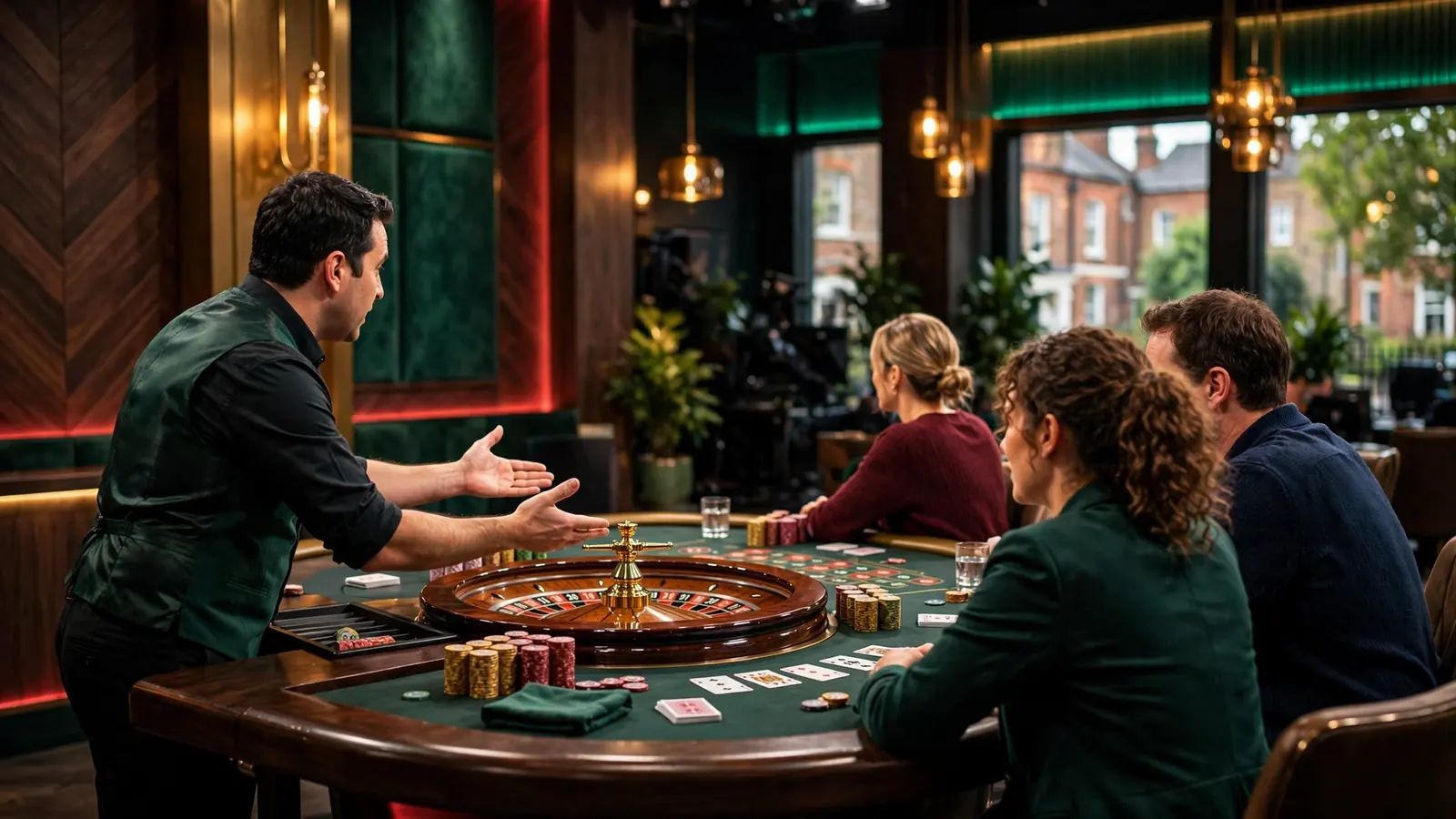
A live Hi-Lo table makes the card flow visible: the previous winning card remains face up as the reference for the next round, while cards from the prior round are returned to a continuous shuffler. That sequence matters because the exposed card is not available to be drawn again from the shoe during the next decision. The table therefore presents both a comparison point and information about which outcome is no longer possible.
The reference card is the starting point for the next prediction. A player considers whether the next winning card will be higher or lower than the value shown. The visible card gives the comparison, but it does not mean that every value remains equally available: the reference card itself has already been removed from the cards that can produce the next result. For proposition bets, an outcome should not be selected if it would be a win only when the exposed card appears. It cannot appear as the next winning card while it is serving as the reference.
Between rounds, three cards are burned before the next winning card is revealed. They are not the result used for the Hi-Lo decision. The distinction is important: the exposed reference card defines the comparison, the burned cards are removed before the winning card is shown, and the next winning card settles the prediction. Treating every card movement as a possible result would confuse the dealing sequence with the outcome itself.
Live Round Sequence
The winning card from the previous hand remains face up as the reference.
Cards from the previous round are returned to the continuous shuffler.
Three cards are burned before the next winning card is revealed.
The new winning card is compared with the exposed reference to settle the prediction.
A specialist review describes a setup using six decks of 48 cards, with tens omitted. That is a description of the setup in that review, not a specification that should be assumed for every live table. The useful point for following a round is the sequence of cards, rather than treating a deck description as a universal rule. The continuous shuffler is also part of that sequence: cards from the previous round go straight back into it.
This differs from a game in which used cards remain out of play throughout a longer run. Here, cards from the prior round are returned to the continuous shuffler immediately, while the current reference card remains exposed for the next round. Those two details should not be collapsed into the vague idea that cards are simply “reused”. The reference card has a specific role in the next comparison; the previous round’s cards are returned to the shuffler.
The sequence can be followed without assuming that the visible reference card is still part of the next possible result:
- The winning card from the previous hand stays exposed as the reference.
- Cards from that previous round are returned to the continuous shuffler.
- Three cards are burned before the next winning card is revealed.
- The new winning card is compared with the exposed reference.
That order is the practical framework for reading a live card table. The reference is not merely a display of the last result. It affects which proposition bets remain coherent, because a bet whose success depends on drawing that same exposed card has no possible winning route in that round. A comparison bet and a proposition bet therefore need not treat the face-up card in the same way: the former uses it as the benchmark, while the latter must account for its absence from the next winning draw.
The continuous shuffler changes what can be inferred from cards seen earlier. Since cards from the previous round are immediately returned, an earlier card does not simply remain unavailable for the rest of play. The exposed reference is the stated exception relevant to the next round: it is visible and used for comparison, but is no longer in the shoe as a possible winning card. The returned cards and the reference card thus have different statuses at the point when the next decision is made.

In a live Hi-Lo casino game, the camera view can make these roles easier to distinguish than a description of the rules alone. The face-up reference card anchors the prediction; the burn cards precede the winning reveal; the continuous shuffler receives cards from the previous round. The result is not determined by the reference card being dealt again. It is determined by the next winning card after the burn, compared against that reference.
For a player tracking a live hand, the operational question is therefore not simply which value was shown last. It is whether that card is the reference for the current decision, whether the bet’s outcome remains possible without drawing it, and which card is actually revealed as the winning one. Keeping those roles separate prevents a misleading reading of the table: a card can remain visible and important to the comparison while being unavailable as the next winning card.
Reference Card
Avoid selecting proposition bets that only win if the exposed reference card appears, as that card is unavailable to be drawn from the shoe.
Live Online Hi-Lo on a Reel
A reel-based live Hi-Lo game uses a different decision from a card-and-shoe version. The player selects whether the result on one reel should be higher or lower, then the reel stops on a number. A result in the selected direction wins; a result in the opposite direction or a tie loses. The relevant comparison is therefore between the chosen direction and the reel’s stopping number, not between two cards drawn from a deck.
That distinction matters when assessing a live Hi-Lo online casino. The word “live” does not make the reel behave like a physical card draw. The decision is attached to a single reel, and the stated outcome rules include ties as losses. A tie is not a push in this format. Someone comparing it with card games should keep the rule sets separate rather than carrying a tie rule from one version into another.
The round’s decision continues after a win. The player can either collect the result and begin again, or parlay the original bet together with the winnings into another play. A parlay keeps the accumulated amount at risk; collecting ends that sequence and returns the win instead of putting it through another decision. The choice changes what happens to the winnings, not the conditions for winning the next reel result.
That makes the two options financially distinct. Collecting fixes the current outcome for that round. Continuing exposes the original stake and the accumulated win to a fresh result, where an opposite-direction number or a tie loses. A larger amount available for the next decision is not the same as a larger expected return: it is simply more money being carried forward into another risk.

A specialist review of this reel game reports a highest return of 96.23% for a Higher bet above 4 or a Lower bet below 10. That figure is tied to those stated choices; it is not a general return for every direction, threshold or live Hi-Lo casino site. Nor does it describe what any single run will pay. The reported return is a long-run measure, while each round still resolves as a win or loss under the game’s stated rule.
The thresholds also make the direction choice concrete. “Higher” and “Lower” are not interchangeable labels: the selected direction determines which side of the relevant number counts as a win. A tie remains a loss, so an outcome that might be treated neutrally in another version does not preserve the stake here. Before placing a bet, the direction and the displayed threshold need to be read together; the return figure alone does not identify the full terms of a particular round.
For live Hi-Lo casino sites in the UK, the practical comparison is the actual reel rules shown for the game, not the shared name. Check whether the game presents one reel, how it defines a directional win, and what it does with a tie. Then distinguish the collect choice from the parlay choice: one closes the winning sequence, while the other puts the current amount through another decision. Those mechanics determine the exposure more directly than the live label.
Fixes the current outcome for the round and returns the winnings.
Keeps the original stake and accumulated winnings at risk for another play.
A win is determined by the direction; opposite directions or ties result in a loss.
The format is therefore best understood as a sequence of directional reel outcomes with a separate choice after each win. It does not use the card-removal logic of a deck game, and it does not turn a tie into a neutral result. The reported return applies to a specific pair of betting conditions, while the collect-or-parlay decision determines whether winnings are taken out of play or risked again.
Checking a Hi-Lo Casino Site in the UK
A Hi-Lo game may be simple to follow; the site offering it still needs to meet the rules for remote gambling. In Great Britain, the UK Gambling Commission is the sole regulator of commercial gambling. Its remit covers remote gambling offered to consumers there even when the operator’s key equipment is based elsewhere. The regulator grants operating licences to gambling businesses and personal licences to individuals working in relevant roles.
The Gambling Act 2005 governs gambling in England, Wales and Scotland, but not Northern Ireland. For a customer in Great Britain, the practical check is whether the business offering the casino service holds the relevant UK Gambling Commission operating licence. An offshore licence is not a substitute for that permission: operators selling remote gambling into the British market must be licensed by the Commission.
Verify the operator, not just the logo
Before depositing, look up the operator on the UK Gambling Commission’s public register and check that its licence is current. Compare the registered business details with the information shown on the casino site. A licence badge or a reference to regulation is not the same as confirming the entry against the regulator’s register. The relevant licence belongs to the business providing the gambling service, so the site’s branding alone is not enough to establish who is responsible.
The register check is also a way to distinguish a UK-licensed casino from a site operating outside the UKGC system. A business based abroad may still fall within the British licensing requirement if it offers remote gambling to consumers in Great Britain. The location of its servers or other key equipment does not remove that requirement.
Age and account controls
A UK-licensed operator must verify a customer’s age before allowing a deposit into a gambling account. Age verification is therefore a gate before funded play, not a box to tick after money has been accepted. Online gambling is legal in the UK for people aged 18 and over when it is provided by an operator holding a UK Gambling Commission licence.
Financial-limit controls are another pre-deposit check. Remote operators must prompt new customers to set a financial limit before the first deposit and make account-level limit controls accessible. The important distinction is between a prompt that appears before funds are added and a control that can later be found and used in the account. A site’s tools should be assessed as account safeguards, not treated as a prediction of how a Hi-Lo session will perform.
UK-licensed casinos must also provide responsible-gambling tools, including self-exclusion. These controls address access to gambling rather than the rules of an individual game. If gambling is becoming difficult to control, GamCare and the National Gambling Helpline provide support; GAMSTOP is the national self-exclusion programme for online gambling.
Check payment restrictions
UK-licensed casinos cannot accept credit cards for gambling. The restriction also applies when credit-card funding is routed through a money service business. A wallet cannot be used to bypass the rule if it allows credit-card funds to be used for gambling. The relevant question is not merely whether the cashier lists a payment method, but whether the funding route complies with the restriction.
These rules are specific to gambling payments. They should not be confused with general claims about how quickly a payment will arrive or what a casino will accept in every circumstance; those details depend on the operator and are not established by the licensing framework alone.
Complaints and accountability
UK Gambling Commission licensees must provide an internal complaints process and access to an approved Alternative Dispute Resolution service. The site should identify how a complaint can be raised and explain the route to ADR if the dispute is not resolved through its own process. Operators are also required to contribute to the Research, Education and Treatment levy.
These obligations do not guarantee a particular outcome in a dispute or remove the need to keep records of account activity and communications. They establish the routes and safeguards that a licensed business must make available.

For a Hi-Lo casino site in the UK, the practical sequence is therefore regulatory rather than promotional: confirm the operator on the Commission’s register, establish that age checks happen before deposits, inspect the financial-limit and self-exclusion controls, and check that payment restrictions and complaint routes are addressed. A game name or a licensing badge, on its own, proves none of those points.
Playing Hi-Lo Online: When to Stop and What a Loss Means
In an accumulating-winnings Hi-Lo game, each decision changes the position of the current game: a correct call adds winnings, while a wrong call ends the run and removes the winnings built up in it. The choice is therefore not simply whether the next card is likely to move up or down. It is also whether the possible gain from continuing is worth putting the current total at risk.
A round begins with a card dealt at random. The player then chooses whether the next card should rank higher or lower, where the distinction is clear enough to make a choice. A correct prediction advances the game and increases its accumulated winnings. After the first decision, the player can stop and collect what has built up so far, or continue with another prediction. That cash-out point is the defining practical choice in this format.
Stopping preserves the amount available to collect at that moment. Continuing keeps the game open, with another opportunity to increase the total but also another chance to lose it. There is no guaranteed route from a successful call to a larger final collection: each further decision exposes the winnings already accumulated to the consequence of a wrong guess. The game’s progress display may make the total look like money already secured; it is not secured until collected.
Attention Winnings are not secured until they are collected; continuing to play exposes the entire accumulated total to the risk of a single wrong guess.
That distinction matters when considering how to play Hi-Lo in an online casino. A player can treat each successful call as a point to reassess rather than as a reason to continue automatically. The relevant comparison is between the amount currently available to collect and the value placed on another attempt. If preserving the existing total matters more than the possibility of increasing it, stopping is consistent with that preference. If continuing is chosen, the current winnings remain exposed.
A wrong guess has a definite effect: all winnings accumulated in that game are void. They are not retained as a smaller payout, and a later round does not restore them. The loss applies to the game in progress, not to a collection already made by stopping. This is why the timing of a cash-out decision matters more than the number of successful calls on its own.
A useful way to keep the decision clear is to separate the game into two states: winnings still in play, and winnings already collected. Before cashing out, the displayed accumulation belongs to the first state. After collection, it is no longer at risk from a later prediction in that game. Mixing the two can make a continuation feel safer than it is, especially when several earlier calls have been correct. Past success does not remove the risk attached to the next choice.
The direction of the next call should also be considered on its own terms. A high or low current card can make one direction appear more attractive, but continuing is still a decision to put the existing accumulation at risk. The choice is not improved merely because the game has already produced a run of correct calls. Nor does the possibility of collecting make a prediction more likely to be right. The cash-out option changes the exposure, not the card outcome.

For players comparing hi lo online casinos in the UK, the displayed rules should make clear how a correct call affects the accumulation, what happens after a wrong call, and when collection is available. Those details determine what a displayed balance means during play. A total that can still be lost should not be read as a payable amount. The exact screen design may vary, but the distinction between continuing and collecting is the central financial one.
A practical stopping rule can be set before a game begins: decide what amount of accumulated winnings would be enough to collect, and stop when that point is reached. It is a control over exposure, not a method for predicting cards or improving the game’s return. Without a pre-set point, each successful call can become a reason to extend the run, while the amount at risk grows with it. A limit on continuation does not alter the rules; it prevents the decision from being made only after the next tempting opportunity appears.

The same principle applies after an early win. There is no obligation to keep playing because the game has started well, and collecting after the first decision is an available choice. Conversely, continuing is not a way to protect the existing total. It exchanges the option to collect now for another chance at a higher total, with the accumulated winnings still exposed to a single incorrect prediction.
For an accumulating-winnings format, the final result is determined not only by the guesses made but by whether the player collects before a wrong one. A correct call can increase the amount in play; it cannot secure that amount. Collection ends that exposure for the winnings already built up, while a wrong guess before collection voids them. That is the full cost of choosing to continue.
Written by the editors at Vegas Moose Casino 3.