Bitcoin Cash casino comparison in the UK: licensing
 Available in GB
Bitcoin Cash payment options, cashouts and casino terms are considered alongside the distinction between UK access and UKGC licensing.

Table of Contents
- What a UK Bitcoin Cash Casino Actually Means
- How BCH Casino Deposits and Withdrawals Work
- BCH Casino Sites and the Offshore Licence Trade-off
- Assessing BCH Casino Terms Without a Best-Sites List
- What “Top” BCH Casino Claims Can—and Cannot—Show
- UK Casinos Accepting Bitcoin Cash: The Licensing Divide
- BCH Slot Deposits, Cashouts and the Waiting Threshold
- Using Bitcoin Cash Across Casino Games
- BCH Casinos, Account Checks and Player Protections
- Bitcoin Cash Blackjack and UK Online-Slot Rules
What a UK Bitcoin Cash Casino Actually Means
The phrase “UK Bitcoin Cash casino” can describe two different things: a casino that accepts customers in Britain, or a casino licensed by the UK Gambling Commission. Those descriptions are not interchangeable. A site may offer BCH payments to people in the UK without holding a UKGC licence; accepting the currency does not make it a UK-licensed casino.
The distinction matters because UK-licensed operators cannot accept cryptocurrency. No casino with a UK licence currently accepts Bitcoin Cash directly, and the Commission’s public register of remote casino licences does not list BCH as a deposit method. A site advertising Bitcoin Cash for gambling therefore does not fit the regulated UK-casino category merely because it is accessible from Britain or uses “UK” in its marketing.
The UK Gambling Commission regulates gambling in the United Kingdom, including online casino activity. Its remote-gambling remit covers services offered to consumers in Great Britain regardless of where the operator’s key equipment is located. In other words, moving servers or payment processing abroad does not, by itself, remove an operator serving the British market from the Commission’s licensing requirements.
The Commission is the sole regulator for commercial gambling in Great Britain. It issues operating licences to businesses and personal licences to individuals working in relevant roles. These are different permissions: an operating licence concerns the business providing gambling, while a personal licence applies to an individual operating within the industry. Neither should be confused with an offshore licence or with a site’s own statement that it is “licensed”.
For a comparison of Bitcoin Cash casinos, the practical starting point is therefore classification rather than the payment logo. A casino with a UKGC operating licence cannot take BCH as a gambling payment. A casino that does take BCH is not thereby a UKGC-licensed casino. Calling the latter a “UK Bitcoin Cash casino” may describe its intended audience, but it does not establish that it is regulated in Britain.
This is also why the word “UK” needs care in listings and promotions. It can refer to the location of customers a site seeks, the currency or language it displays, or the regulator overseeing its gambling services. Only the last of those establishes UKGC licensing. The regulator’s public register is the relevant record for that status; branding and payment options are not substitutes.
The result is a narrow but important meaning: a UK-licensed casino is a business authorised by the Commission to provide gambling in the British market, and it cannot accept BCH. A Bitcoin Cash casino available to UK residents belongs to a separate category unless it holds the required UKGC licence—and the direct BCH payment model rules that out for UK-licensed casinos. The payment method and the licence status must be read as separate facts, not as two labels that confirm one another.
How BCH Casino Deposits and Withdrawals Work
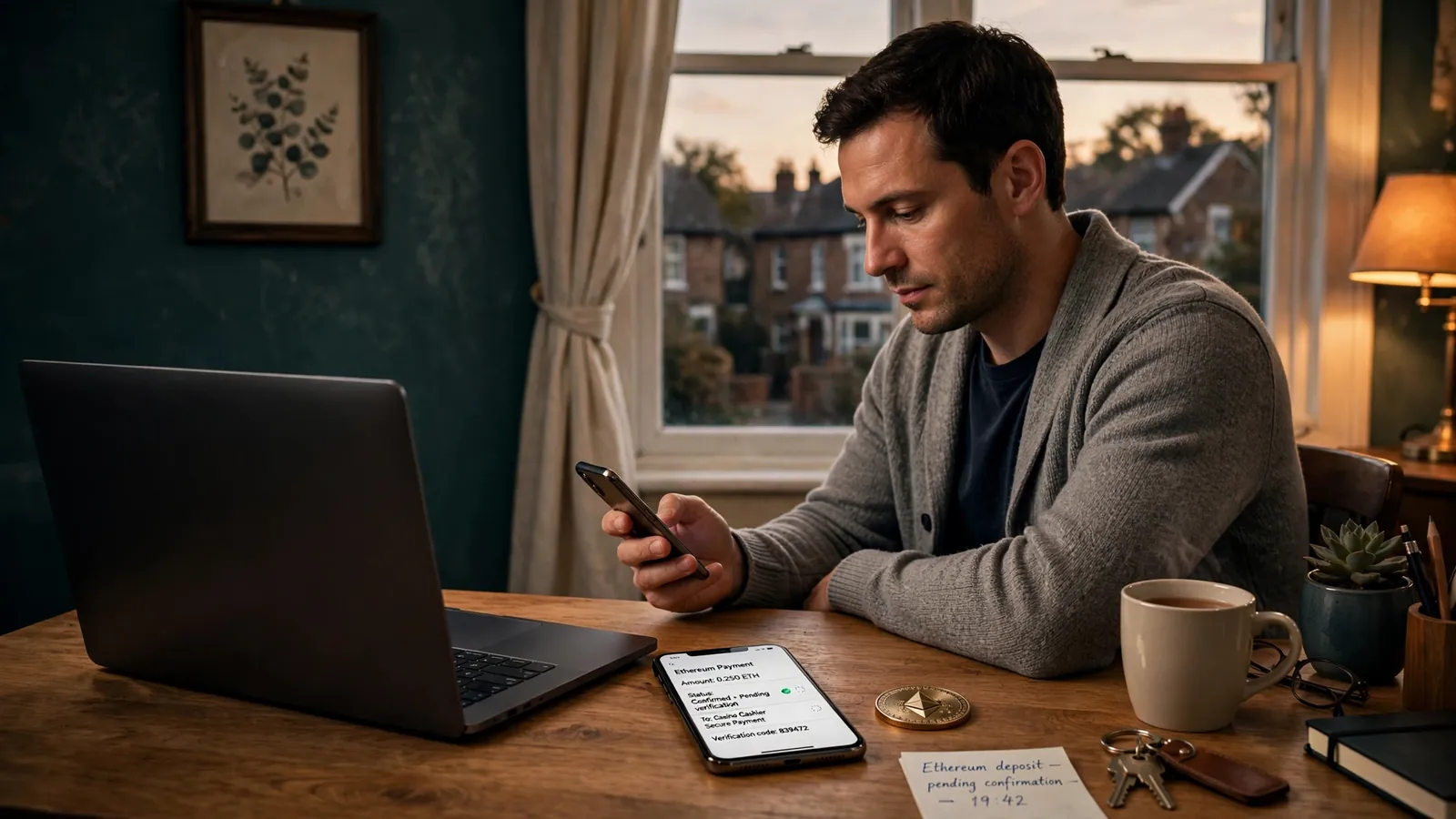
A Bitcoin Cash payment moves between digital wallets rather than through a bank card account. At an offshore casino that accepts BCH, the deposit flow generally starts with a cashier page displaying a payment address or a QR code. The player sends BCH from a personal wallet to that address. The casino then has to identify the incoming transaction and credit the account under its own payment procedure.

The address matters: it is the destination for that particular transfer, not a general casino account number. The wallet’s send screen normally provides a place to enter or scan the destination and specify the amount. Before confirming, the sender can check that the currency is BCH, the address matches the casino’s displayed details and the amount is correct. A transfer sent on the wrong network or to an incorrect address may not be recoverable through the usual payment flow.
After broadcast, the transaction is included in the Bitcoin Cash blockchain. A casino needs to recognise it before the balance appears as available funds. A specialist review reports that BCH casino deposits commonly wait for a single on-chain confirmation, with that confirmation taking 10 minutes. That is a reported timing, not a fixed arrival promise: network processing and the casino’s crediting procedure are separate steps. A transaction can be visible on-chain while the account balance has not yet updated.
Attention: A transfer sent on the wrong network or to an incorrect address may not be recoverable through the usual payment flow.
The transaction identifier, often called a transaction hash, can be used to locate the transfer on a public blockchain explorer. It helps distinguish a payment that has been broadcast from one that has received confirmation. It does not itself make the casino credit the account; that depends on the operator recognising the transaction and applying its own process. Keeping the identifier and the payment details makes it easier to describe a deposit that has not appeared, without relying only on a wallet’s outgoing-payment label.
What the network fee covers
A BCH transfer includes a network fee paid for processing the transaction. This is different from a casino charge: the wallet sends the fee to the network, while any separate casino fee would be a condition set by the operator. The amount of the network fee is not a universal fixed figure. It can depend on the wallet’s settings and the transaction being submitted, so the final cost should be read on the wallet screen before approval rather than inferred from the deposit amount.
Bitcoin Cash transactions are generally cheaper and faster than Bitcoin transactions. One reason is BCH’s 32MB block-size limit, which allows more transaction data to be included in a block than Bitcoin’s smaller limit. That comparison does not mean every BCH payment is instant or fee-free. The network must still process a transaction, and the casino may wait for confirmation before making the deposit usable.
The value credited can also be affected by how the casino handles currency conversion. Where an account or displayed balance is denominated in something other than BCH, the operator may show a converted value. The transfer itself remains a BCH transaction; a display conversion does not change what was sent across the network. The payment screen and account history are therefore distinct records: one shows the blockchain transfer, the other shows how the casino has reflected it.


Withdrawals reverse the direction
For a BCH withdrawal, the casino sends funds to a wallet address supplied by the account holder. The process commonly begins with a withdrawal request in the cashier, followed by entry or selection of a destination address and confirmation of the amount. The address should be checked before submission because a blockchain transfer is not a card payment that can simply be reversed by contacting a bank.
Once the casino broadcasts the withdrawal, the transaction can be tracked on-chain using its identifier. The casino’s status may show a request as pending before any transaction appears publicly; that indicates the operator has not yet broadcast it. After broadcast, network confirmation is the next stage. These are different timings: the casino’s internal handling comes first, and blockchain processing begins only once the transaction has been sent.
A wallet-based system also means the destination address is part of the withdrawal instruction. A casino may ask for account authentication or other information before releasing funds; the exact process depends on the operator. The wallet does not decide whether a casino approves a request, and a blockchain explorer cannot establish why an operator has not yet sent it. It can show whether a transaction exists and what has happened to it on-chain.
Traceability and records
BCH is not anonymous cash. Each transaction is recorded on a public ledger, where addresses and transfer amounts are visible. The ledger does not automatically display a person’s name, but chain-analysis firms can often connect deposits to a known exchange. If BCH was acquired through an exchange account associated with an identity, the path between that exchange and a casino deposit may be traceable.
Chain-analysis firms can often connect deposits to a known exchange if BCH was acquired through an account associated with an identity.
This makes wallet separation a matter of record-keeping, not a guarantee of privacy. A personal wallet can make it easier to distinguish casino transfers from other activity, but it does not erase the public transaction history or prevent analysis from connecting addresses. The practical payment record consists of the casino’s deposit or withdrawal entry, the wallet’s transaction details and the corresponding blockchain record. Keeping those consistent is more useful than treating a crypto transfer as an unrecorded cash movement.
BCH Casino Sites and the Offshore Licence Trade-off
A Bitcoin Cash casino may be available to someone in the UK without being authorised to serve the British market. These are separate questions: whether an offshore site accepts a UK customer, and whether its operator holds a Gambling Commission licence. A foreign licence does not substitute for the UK licence required of operators offering remote gambling to consumers in Great Britain.
The UK Gambling Commission regulates commercial gambling in Great Britain. Its remit covers remote gambling offered to people there, even when an operator’s equipment or business is based elsewhere. An offshore casino sits outside that system if it has no UKGC licence. Its own licensing claims, terms and complaint arrangements do not create access to the Commission’s protections.
A specialist review of a particular selection of Bitcoin Cash gambling sites reported that every operator it covered held a Curacao or similar offshore licence. That describes the selection reviewed, not the whole market or a permanent status. Licence details can change, and the presence of an offshore licence does not establish that a site is authorised to offer gambling to consumers in Great Britain.

The legal position for an individual is distinct from the operator’s obligations. The UK does not criminalise an individual for gambling with an offshore operator. That does not make the site a UK-licensed casino, or mean that online gambling there is covered by UK rules. The practical trade-off is access without the UKGC regulatory safety net.
What account checks can—and cannot—tell
A specialist review has also reported that most offshore BCH casinos in its coverage permitted account creation with an email address and password, without the traditional identity checks at registration. This is a description of the sites reviewed, not a guarantee about current registration practices across Bitcoin Cash casino sites UK players may encounter.
A short sign-up process is not evidence that verification will never be required. The operator’s terms may still allow it to request identity or account documents later, and the site’s initial registration screen cannot establish how a later check will be handled. The material point is that an offshore operator does not provide the same UKGC-regulated account protections as a licensee serving the British market.
UK-licensed operators must verify a customer’s age before allowing a deposit. They must also provide account-level limit controls and prompt new customers to set a financial limit before their first deposit. UKGC licensees must offer an internal complaints process and access to an approved Alternative Dispute Resolution service, alongside responsible-gambling tools that include self-exclusion. Those requirements should not be assumed to apply to an offshore Bitcoin Cash deposit casino.
Complaints and self-exclusion
A site taking BCH without a Commission licence is not part of GAMSTOP. A customer who has registered with GAMSTOP should not treat an offshore account as covered by that exclusion. The same separation applies if a dispute arises: offshore customers do not have access to UKGC dispute resolution or an approved ADR route through the Commission’s licensing framework.
No UKGC Protection
Offshore casinos are not part of GAMSTOP and do not provide access to UKGC dispute resolution or approved Alternative Dispute Resolution (ADR) services.
The distinction matters when an account is restricted, a withdrawal is disputed or the operator interprets its terms differently from the customer. A site may have its own complaint process, but that is not the UKGC complaints route and does not provide the same independent, approved ADR access required of UK licensees. The relevant protection is not established simply by a website displaying a licence badge or a customer-support link.
For a site claiming to hold a UK licence, the operator’s licence number can be checked against the Gambling Commission’s public register before a deposit is made. An offshore licence is not a substitute entry on that register. If the operator is absent from the UKGC register, the account should be understood as outside the British regulatory framework, whatever payment methods or games the site advertises.
The calculation is therefore straightforward: no criminal liability for the individual does not equal UKGC oversight, complaint access or GamStop integration. Those protections do not travel with Bitcoin Cash.
Assessing BCH Casino Terms Without a Best-Sites List
A comparison of BCH casinos is more useful when it tests conditions than when it assigns a winner. The first condition is licensing. A casino accepting Bitcoin Cash is not thereby a UK-licensed casino: operators serving Great Britain under a UKGC licence cannot accept cryptocurrency. A site that accepts BCH therefore sits outside that licensing arrangement, and the protections attached to UKGC-regulated gambling do not follow the payment method.

Licence claims should be checked against the regulator’s public register, not inferred from a logo or a payment page. The name of a licensing jurisdiction is not proof that a particular operator holds a current licence there, and an offshore licence is not a substitute for UKGC authorisation. This distinction matters before any comparison of bonuses: a generous offer cannot compensate for an absent UKGC complaints route, approved ADR or GamStop integration. Offshore play is not criminal for UK individuals, but it does not provide the UKGC regulatory safety net.
Payment terms are the next comparison point. The cashier and terms should make clear whether BCH is accepted for both deposits and withdrawals, which network is supported, and whether the casino applies its own transaction charges or limits. The relevant conditions are the ones that determine what reaches the account and what can leave it. A headline claim that a site accepts Bitcoin Cash does not settle those details. Any restriction should be read alongside the withdrawal rules, rather than treated as a minor footnote after a deposit has been made.
Bonus arithmetic needs the same scrutiny. A specialist review reports welcome offers in the form of deposit matches between 100% and 200%, with wagering requirements of 20x to 50x the bonus amount. Those figures describe that review’s reported offers, not a fixed schedule across BCH casinos. The face value is only the starting point: the wagering base, eligible games, expiry conditions and maximum cashout can determine whether the advertised bonus has practical value. A percentage match says little about the amount that can ultimately be withdrawn.
- Check licence status against the public register
- Verify BCH payment and withdrawal conditions
- Scrutinize wagering bases and cashout caps
- Rely on logos or payment pages for licence proof
- Assume an offshore bonus matches UKGC rules
- Treat promotional percentages as guaranteed value
The UKGC’s bonus wagering cap has applied to its licensees since 19 December 2025. That rule does not turn an offshore BCH offer into a UKGC-regulated offer, so the operator’s status must be established before comparing a stated wagering condition with the licensed-market rule. Treating the two as equivalent would make the arithmetic look cleaner than the underlying terms.
No-deposit offers require a separate calculation. A specialist review characterises them as less common at BCH casinos than at traditional UK sites and reports high wagering requirements paired with low maximum cashouts when they appear. The apparent free value can therefore be limited twice: by the work required to meet the wagering condition and by the ceiling on funds that may be withdrawn. The stated cashout cap deserves attention before the bonus amount.
A useful comparison records the licence position, the exact BCH payment conditions and the bonus rules in separate fields. It does not convert a promotional percentage into a verdict or assume that a payment option establishes legitimacy. Where a condition is unclear, the uncertainty itself is part of the comparison; it is not a reason to fill the gap with the operator’s headline claim.
What “Top” BCH Casino Claims Can—and Cannot—Show
For a UK-focused Bitcoin Cash casino comparison in 2026, payout speed is one practical detail to check when choosing where to play. The entries below note the payout information available for each operator.
Payout speed: 1-3 business days x3bet lists a payout speed of 1–3 business days.
Payout speed: 1-3 business days NightWin lists a payout speed of 1–3 business days.
Payout speed: 1-3 business days Britsino lists a payout speed of 1–3 business days.
Payout speed: 1-3 business days NightLuck lists a payout speed of 1–3 business days.
Payout speed: 1-3 business days SpinFormula lists a payout speed of 1–3 business days.
Payout speed: 1-3 business days Chanze lists a payout speed of 1–3 business days.
Payout speed: 1-3 business days WinBeast lists a payout speed of 1–3 business days.
Payout speed: 1-3 business days Revery Play lists a payout speed of 1–3 business days.
Payout speed: 1-3 business days Amunbet lists a payout speed of 1–3 business days.
Payout speed: 1-3 business days EvoSpin lists a payout speed of 1–3 business days.
Calling a Bitcoin Cash casino “top” is a promotional judgement, not a cashout condition. The label does not state how long a withdrawal takes, whether a request is checked before release, or what amount triggers additional handling. Those details need to be read separately from a ranking or recommendation.
A specialist review reported that BC.Game and Stake processed BCH cashouts within ten minutes of a request, with some taking less than five. That is a reported observation, not a standing service commitment. It describes processing after a request was made; it does not establish that every withdrawal will follow the same timetable or that the funds will be available in a wallet at that point. A ranking that repeats a fast result without identifying it as a report can make a limited observation sound like a dependable term.
The same distinction applies to withdrawal thresholds. A specialist review described several casinos placing withdrawals above a set amount into a “management review” queue. The reported thresholds ranged from 0.5 BCH to the equivalent of 2 BCH. The range is material: a payment below a threshold may be handled differently from one above it, and a threshold stated in BCH equivalent may not represent a fixed sterling amount as the exchange value changes. The reported range should not be treated as a universal rule for BCH casinos.
A useful comparison therefore separates three things:
- Published terms: the casino’s own stated withdrawal conditions, including any review threshold.
- Observed processing: what a review reports about the time between requesting a cashout and casino processing.
- Promotional language: a “top” badge, ranking position or general claim of speed.
Only the first is a stated condition; the second is evidence of an observed outcome, and the third is not a measurable payment term. Even a clear processing claim leaves open whether a request can be held for review, so the threshold and the reported timing should not be collapsed into one headline figure.
For a top Bitcoin Cash casino claim to carry practical weight, it needs to be supported by concrete cashout conditions rather than adjectives. A reported sub-five-minute result may sound decisive, but it does not answer whether larger requests enter a review queue. Conversely, a disclosed threshold gives a comparison point but does not say how quickly a withdrawal below it will be processed.
The useful result is not a winner’s label. It is a record of what the operator says about withdrawals, what a specialist review has observed, and where the two differ. That makes the uncertainty visible instead of allowing a promotional ranking to stand in for a payment promise.
Processing and Terms
- Published terms are the only binding cashout conditions
- Observed processing times from reviews are not service commitments
- Management review thresholds can vary between 0.5 BCH and 2 BCH
- Promotional rankings do not replace concrete payment terms
UK Casinos Accepting Bitcoin Cash: The Licensing Divide
A casino can accept Bitcoin Cash and still have no UK Gambling Commission licence. The payment method describes what the operator will take; it does not establish which regulator authorises the business. A site serving British customers through an offshore licence remains outside the UKGC system, even if its pages are written for the UK market or show balances in pounds.
The distinction is confirmed by the Commission’s public register. No operator listed there for a remote casino licence currently identifies Bitcoin Cash as a deposit method. UK-licensed operators are also prohibited from accepting cryptocurrency, so a casino with a UKGC licence cannot offer BCH as a direct payment option. Taken together, those points mean there is no UK-licensed casino currently accepting Bitcoin Cash directly.
The phrase “UK casino accepting BCH” can therefore describe a site available to someone in the UK, not a casino licensed in the UK. Availability and regulatory status are separate matters. A business may permit account access from Britain and accept BCH while operating under an offshore licence; that does not make it a UK-regulated casino. For remote gambling offered to British consumers, the UKGC licence is the relevant local authorisation.
That difference has practical consequences. Offshore casino play is not itself a criminal offence for an individual in the UK, but it does not bring the UKGC regulatory safety net. There is no access to UKGC dispute resolution or an approved alternative dispute resolution service, and the site is not integrated with GamStop. A complaint about the operator therefore does not follow the route available for a UKGC-licensed casino.
The label “crypto casino” does not settle any of these questions. It indicates that a cryptocurrency may be accepted, but says nothing by itself about the operator’s legal authorisation, the regulator responsible for it, or the protections available to a British customer. Those details need to be read separately from the payment options.
A useful check is whether the operator appears on the Commission’s public register with the relevant remote casino licence. A licence claim on the casino’s own website is not the same thing as a listing on that register. The register’s lack of BCH deposit listings is not a technical gap in the record: it reflects the prohibition on cryptocurrency acceptance by UK licensees.
As a result, “casinos accepting Bitcoin Cash” and “UK-licensed casinos” are not interchangeable categories. A site may accept BCH, but that acceptance points away from UKGC licensing rather than demonstrating it. For a British player, the key distinction is whether the operator holds the required UK licence; where it does not, the UKGC complaints route, approved ADR and GamStop integration are absent.
BCH Slot Deposits, Cashouts and the Waiting Threshold
Funding slot play with Bitcoin Cash involves two separate clocks: the blockchain’s confirmation of a deposit and the casino’s handling of a withdrawal. A quick result at one stage does not establish how quickly the other will be completed.
BCH Deposit Flow
The player accesses the cashier page to obtain a payment address or QR code.
BCH is sent from a personal wallet to the specified casino address.
The transaction is included in the blockchain, typically requiring one confirmation (~10 minutes).
The casino identifies the transaction and updates the account balance.
A specialist casino review reports that BCH deposits typically receive one on-chain confirmation, with that confirmation taking around 10 minutes. The casino can then credit the account, but the blockchain confirmation and the account update are distinct steps. A delay in the latter is not necessarily a delay in the transaction itself.
Withdrawals reverse the direction of the payment, but they do not simply reverse the timing. Once a casino approves a request and sends BCH, the transaction must be recorded on-chain. Before that point, the operator controls its own review and release process. A displayed withdrawal status therefore needs to be read carefully: “requested”, “approved” and “sent” describe different stages.
A specialist review reports BCH cashouts at BC.Game and Stake as being processed within 10 minutes of a request, often in under five. That is a report about those operators, not a general service standard for Bitcoin Cash casino payouts. The interval may describe the operator’s processing rather than the time until the transaction receives on-chain confirmation; the two should not be treated as interchangeable.
The same kind of review reports that several casinos may hold withdrawals above a stated threshold for a “management review”. The reported trigger ranges from 0.5 BCH to 2 BCH equivalent, depending on the casino. That threshold can change whether a withdrawal proceeds directly or waits for an internal decision. It is not a blockchain rule, and the BCH equivalent may be relevant where the casino expresses the threshold in another currency.
For a fast payout Bitcoin Cash casino, the useful distinction is between a short processing report and a binding cashout condition. A review’s observed time does not guarantee the same result for every request. The written terms and withdrawal status determine whether a request is awaiting casino approval or has actually been broadcast to the network.

Bitcoin Cash can fund slot play, but it does not change the rules governing the casino. Where the site is an offshore casino, players do not have the UKGC regulatory safety net, UKGC dispute resolution or access to approved alternative dispute resolution. Such a site is also not integrated with GamStop. Speed of payment is a timing measure, not a substitute for those protections.
Using Bitcoin Cash Across Casino Games
Bitcoin Cash describes a way to fund an account, not a type of casino game. A site’s BCH option concerns deposits and, where supported, withdrawals; it does not define whether the account offers table games, slots or other formats. The games available are determined by the casino, while the payment method sits in the account’s cashier.
At a Bitcoin Cash casino outside the Commission’s licensing system, deposits generally use a wallet-based process. Once funds appear in the account, the balance may be used for the games the operator makes available. The game itself does not become a blockchain transaction: BCH is used to move value between a wallet and the casino, while play takes place within the casino account.
That distinction matters when comparing costs. A deposit method and a game have separate terms. BCH handling concerns the transfer and any conditions attached to funding or withdrawing. Game rules concern how a title works, its stakes and its own terms. A single payment option should not be treated as evidence that every game has identical rules or settlement conditions.
The same separation applies to withdrawals. A casino may offer BCH as a way to receive funds, but the withdrawal process belongs to the operator as well as the payment network. The game played does not, by itself, establish when a payment will be approved or sent.
BCH is used only to move value between a wallet and the casino; the actual gameplay takes place within the casino account and is not a blockchain transaction.
No UK-licensed casino currently accepts Bitcoin Cash directly. Accordingly, the phrase “Bitcoin Cash casino games” describes games played through a casino account funded with BCH, not a distinct class of UK-regulated games. A BCH payment label is not a certification of the casino, its games or their terms. The practical comparison is between the account’s payment conditions and the rules of each game, kept as separate decisions rather than bundled into one feature.
BCH Casinos, Account Checks and Player Protections
A Bitcoin Cash casino outside the UK Gambling Commission’s licensing system may make account creation look simple. Wallet-based deposits and limited identity checks can mean less information is requested at registration, but that does not establish what checks will be required later.
A specialist review reports that some offshore BCH casinos permit registration with an email address and password, without the traditional checks commonly associated with KYC procedures. That is a report about particular sites, not a reliable rule for every operator. Account terms can differ, and a site may request identity documents when processing a withdrawal or reviewing an account. Minimal checks at sign-up therefore do not mean that an account will remain unrestricted.

The UK has a separate age-control requirement: an operator must verify a customer’s age before allowing a deposit. A short registration form should not be treated as proof that this obligation has been met, or as evidence of UKGC oversight.
That distinction affects protection as well as onboarding. An offshore BCH casino is outside the UKGC regulatory safety net. Its customers do not have access to UKGC dispute resolution or an approved alternative dispute resolution service, and a site accepting Bitcoin Cash without a Commission licence is not part of GAMSTOP. A familiar-looking account page or a request for identity documents does not change those limits.
Using an offshore casino is not itself a criminal offence for an individual in the UK. The absence of player criminal liability, however, does not create UKGC supervision or a UK complaints route. Those are separate questions: one concerns the player’s legal position, the other the protections available if an account is restricted or a dispute arises.

The practical value of a low-friction account is therefore narrow. It may reduce the information requested at registration, while leaving uncertainty about later verification and removing access to UKGC-backed protections. An account setup that asks for little is not, by itself, evidence of a safer or more accountable service.
Bitcoin Cash Blackjack and UK Online-Slot Rules
Bitcoin Cash describes a payment method, not a form of blackjack. A table game’s rules and outcomes are separate from the currency used to fund an account. A site may advertise blackjack alongside BCH deposits, but that does not make it a UK-licensed casino: no casino licensed in the UK currently takes Bitcoin Cash directly.
That distinction matters for anyone considering a BCH-funded blackjack account. If the operator is an offshore casino, the player has no UKGC regulatory safety net, access to UKGC dispute resolution or an approved alternative dispute resolution service. The site will not be integrated with GamStop either. Offshore gambling by individuals is not criminalised in the UK, but the absence of player liability does not supply the protections attached to a UKGC licence.
Online-slot rules are a separate matter. They apply to slots in Britain, not specifically to games funded with Bitcoin Cash. Autoplay is banned, and each online slot spin must last at least 2.5 seconds. Those requirements do not set blackjack rules or change how BCH functions as a payment method.
The distinction prevents a common category error: payment choice does not determine which game rules apply, and a game label does not establish the operator’s regulatory status. A BCH blackjack offer and a slot session funded by BCH may involve the same payment method, but only the slot session is subject to the specific autoplay and spin-duration requirements described above. Those restrictions concern the operation of online slots in Britain; they are not conditions attached to Bitcoin Cash itself.
Can I legally deposit Bitcoin Cash at UK casinos?
UK law does not criminalise individuals for gambling with offshore operators, but UK-licensed casinos cannot accept BCH. A casino taking BCH is not a UKGC-licensed casino.
What happens to identity verification at a Bitcoin Cash casino operating outside UK licensing?
Offshore BCH casinos often use wallet-based deposits and minimal identity checks; many allow account creation with only an email address and password.
How fast are Bitcoin Cash casino withdrawals?
BC.Game and Stake have processed BCH cashouts within 10 minutes of a request, often in under five. Other casinos may hold larger withdrawals for management review, with thresholds ranging from 0.5 BCH to 2 BCH equivalent.
Are Bitcoin Cash casino winnings taxable in the UK?
No. Gambling winnings are not subject to UK income tax or capital gains tax, regardless of whether you played with GBP or cryptocurrency.
Does any Gambling Commission-licensed casino currently accept Bitcoin Cash deposits?
No. UK-licensed operators cannot accept cryptocurrency, and no UK-licensed casino currently accepts BCH directly.
Created by the ”Vegas Moose Casino 3” editorial team.